


AI Assistant Showdown 2025: ChatGPT vs. Copilot vs. Gemini & Top Challengers
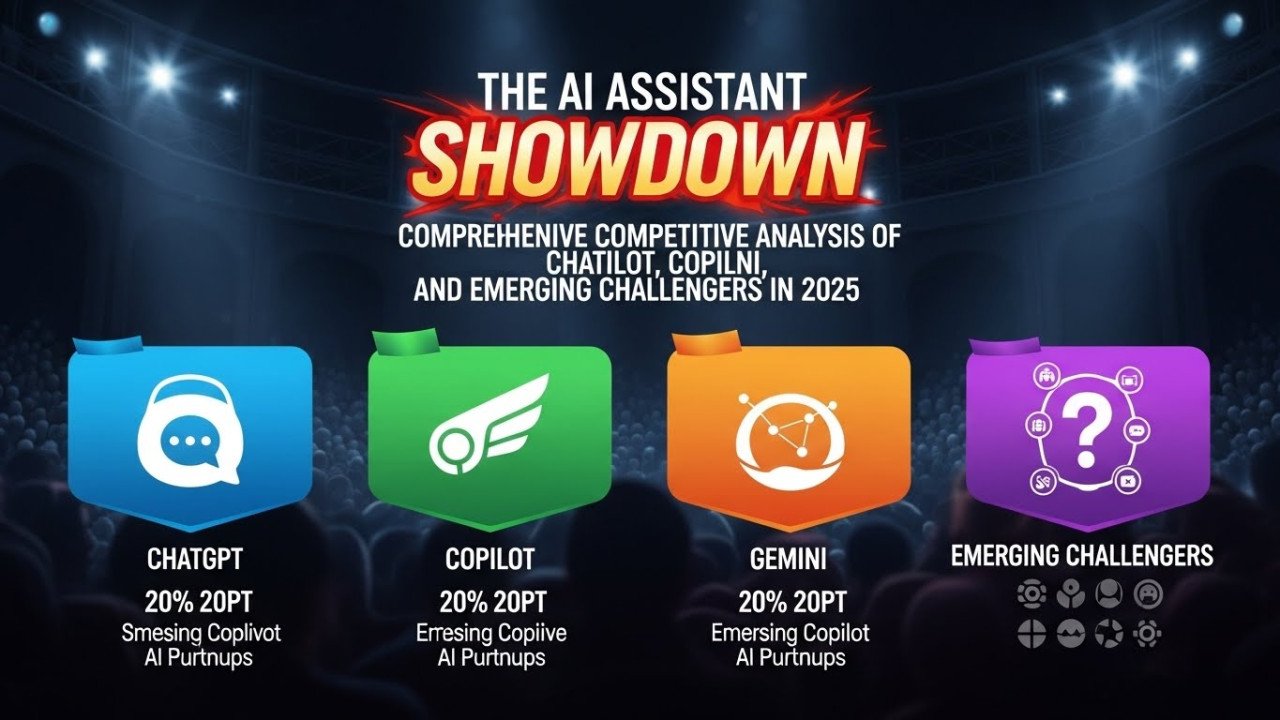
The AI Assistant Showdown: Comprehensive Competitive Analysis of ChatGPT, Copilot, Gemini, and Emerging Challengers in 2025
The artificial intelligence landscape has evolved dramatically over the past two years, transforming from a marketplace with one dominant player into a competitive ecosystem where multiple sophisticated platforms compete for professional attention. This democratization of access to advanced AI capabilities has fundamentally shifted how individuals, teams, and organizations approach research, creativity, productivity, and technical work.
Yet this proliferation creates genuine complexity. Professionals face meaningful choices about which platform aligns with their actual workflows, priorities, and economic constraints. ChatGPT remains the most widely adopted platform globally, yet Copilot excels for Microsoft ecosystem users, Gemini delivers multimodal capabilities Google's ecosystem enables, and emerging platforms like Claude, Perplexity, and others carve out specialized positioning around specific use cases.
Rather than declaring universal winners, this analysis examines each platform's distinctive strengths, realistic limitations, pricing structures, and optimal use scenarios—providing professionals the frameworks to make informed decisions matching their actual needs.
The Competitive Landscape: Understanding Strategic Positioning
The contemporary AI assistant market has evolved into a segmented ecosystem where platforms compete primarily through strategic differentiation rather than technological homogeneity. While all leading platforms employ sophisticated language models delivering impressive performance, they've chosen different distribution strategies, ecosystem integrations, and value propositions that appeal to distinct user segments.
ChatGPT positioned itself as the universal generalist—a standalone platform accessible from any device, requiring no existing ecosystem commitment, optimized for pure conversational capability and creative work. OpenAI's strategy involved neither bundling with existing products nor requiring organizational adoption. Instead, the company drove adoption through sheer capability, ease of use, and network effects that made ChatGPT the default choice for millions of users globally.
Microsoft Copilot pursued the opposite strategy entirely—integrating deeply into Microsoft's ecosystem spanning Windows, Office applications, Teams, GitHub, and Azure. Rather than competing in isolation, Copilot leveraged existing user bases, organizational relationships, and distribution advantages that made AI assistance seamlessly available within workflows where users already worked.
Google Gemini similarly leveraged distribution advantages through Google Search, Gmail, Docs, Sheets, and Maps—platforms used by billions daily. Gemini's positioning emphasized multimodal capability and seamless integration into existing productivity workflows, particularly valuable for organizations already committed to Google's ecosystem.
Claude from Anthropic differentiated through emphasis on safety, reasoning capability, and alignment with user values rather than attempting to compete on scale. The platform attracted users prioritizing ethical AI development and sophisticated reasoning over market dominance or ecosystem integration.
These strategic choices created a landscape where selection depends less on abstract technological superiority and more on alignment with existing workflows, ecosystem commitments, and priority values.
ChatGPT: The Generalist Pioneer and Current Market Leader
ChatGPT's market dominance reflects both technological capability and strategic positioning that captured mindshare during the initial AI adoption wave. The platform maintains approximately 700 million users globally, commanding roughly 80% market share among consumer AI assistants—an extraordinary concentration that testifies to either exceptional product fit or network effects advantages that are difficult for competitors to overcome.
Distinctive Strengths
ChatGPT's strength emerges from the combination of sophisticated underlying models (GPT-4, GPT-4 Turbo, and the emerging GPT-5 family), broad accessibility, and community network effects that have driven ecosystem development around the platform.
Creative capability represents one area where ChatGPT maintains measurable advantage. The platform excels at writing tasks, content generation, ideation, and creative refinement. Writers, marketers, and content creators often discover that ChatGPT's creative capabilities and writing quality exceed alternatives. The iterative refinement through conversation enables users to guide creative direction through natural language dialogue rather than explicit prompting.
Reasoning transparency constitutes another differentiator. ChatGPT's Canvas feature displays reasoning in a separate interface from conversation, making the thinking process visible and editable independently from dialogue. This capability proves particularly valuable for users conducting complex analysis where understanding reasoning steps matters.
Ecosystem integration through plugins and Custom GPTs allows developers to extend ChatGPT's capabilities. Users can access hundreds of specialized ChatGPT applications designed for specific industries or use cases without requiring technical development skills.
Video understanding and generation through Sora represents another capability threshold—OpenAI's investment in multimodal video generation provides capabilities still nascent in competitor offerings.
Market adoption and community means most questions users encounter have likely been addressed somewhere in ChatGPT communities, extensive documentation, and shared prompts—lowering the learning curve for new users.
Acknowledged Limitations
ChatGPT's dominance shouldn't obscure genuine limitations that competitors are exploiting successfully.
Knowledge cutoff remains problematic for time-sensitive research. While ChatGPT provides web browsing capability to address this, the feature remains inconsistent, sometimes disabled, and subordinate to conversational capabilities rather than integrated throughout.
Cost structure at $20 monthly for Plus tier and significantly higher for Team/Enterprise plans creates pricing barriers for casual users or price-sensitive segments—disadvantaging it versus free and low-cost alternatives.
Ecosystem lock-in creates switching friction once users have invested time building Custom GPTs or establishing workflows—a vulnerability if competitors provide substantially better value.
Multimodal limitations compared to Gemini mean that projects requiring sophisticated image, audio, or video analysis might demand supplementary tools.
Hallucination rates remain relevant for research requiring high factual accuracy. Studies suggest GPT-5 error rates around 25% for complex queries—higher than acceptable for certain professional applications.
Microsoft Copilot: The Ecosystem Specialist
Microsoft's strategic positioning as enterprise-integrated AI assistant represents fundamentally different competitive approach than ChatGPT's consumer-first positioning. Rather than building a standalone sensation, Microsoft embedded AI assistance throughout its ecosystem, making Copilot invisible infrastructure rather than explicit application.
Distinctive Strengths
Ecosystem integration represents Copilot's most defensible advantage. For organizations already committed to Microsoft 365, the ability to access AI assistance seamlessly within Word, Excel, Teams, Outlook, and OneNote without context-switching proves operationally valuable. This integration advantage grows as Microsoft expands Copilot throughout the ecosystem.
Productivity automation specific to Microsoft applications enables capabilities unavailable in standalone tools. Excel can accept natural language formula requests. Word can analyze document structure and recommend improvements. Teams can summarize meetings automatically. Outlook can draft responses contextually aware of previous emails.
Enterprise security and governance through Azure infrastructure provides compliance capabilities that privacy-conscious organizations require. Microsoft's commitment to not training models on customer data addresses significant enterprise concerns.
Developer tool integration through GitHub Copilot provides code assistance integrated directly into development workflows. The recent expansion allowing selection between GPT-4, Claude, Gemini, and o3-mini models gives developers unprecedented choice.
Flexible model access through GitHub Copilot Pro ($100/year) provides access to multiple leading models (GPT-4o, Claude 3.5 Sonnet, Gemini Flash 2.0, o1, o3-mini) at lower cost than equivalent standalone subscriptions—a remarkable value proposition for power users.
Acknowledged Limitations
Standalone capability lags ChatGPT for pure conversational use outside Microsoft applications. If you're not using Microsoft products, Copilot doesn't integrate into your workflow.
Feature completeness in free version involves restrictions that encourage paid adoption—5 responses per conversation, character upload limits—more restrictive than generous free tiers competitors offer.
Quality inconsistency in some applications creates frustration. Early Copilot implementations in Microsoft 365 showed accuracy issues and inconsistent performance that recent updates have only partially addressed.
User adoption within organizations remains slower than anticipated, with many companies still trialing Copilot rather than committing organization-wide.
Limited web integration compared to Google. Copilot primarily works within Microsoft applications rather than as standalone research tool across the web.
Google Gemini: The Multimodal Powerhouse
Google's Gemini represents the company's answer to ChatGPT competition, though Gemini's positioning emphasizes multimodal capability and Google ecosystem integration rather than attempting direct ChatGPT replication.
Distinctive Strengths
Multimodal sophistication represents Gemini's most impressive capability. The platform processes text, images, audio, and video—sometimes simultaneously within single queries. This multimodal depth exceeds competitors significantly. Video understanding particularly stands out; Gemini can analyze video content, extract information, and generate descriptions with capability that ChatGPT and Copilot still lack.
Google ecosystem integration means Gemini users can access AI assistance within Gmail, Docs, Sheets, Slides, Maps, Search, and Drive. For organizations committed to Google's ecosystem, this integration rivals Microsoft's Copilot advantage.
Real-time information access through Google Search integration enables Gemini to access contemporary information more reliably than ChatGPT's inconsistent web browsing or Copilot's limited search capability.
Speed and responsiveness particularly in Gemini Flash model variant delivers fast responses suitable for rapid iteration and brainstorming.
Advanced multimodal generation through Veo 3.1 for video creation and Nano Banana for image generation provides creative capabilities matching or exceeding competitor offerings.
Context window scale up to 1 million tokens (with Advanced plans) enables analysis of entire documents, codebases, or research repositories simultaneously—a substantial advantage for document-heavy analysis.
Acknowledged Limitations
Weaker coding support compared to ChatGPT and Copilot limits Gemini's appeal for developer-focused work.
Advanced capabilities require paid subscription more completely than alternatives. The free tier is genuinely limited compared to generous free offerings from competitors.
Integration less seamless than Microsoft's deeper Office integration or ChatGPT's standalone ubiquity—Gemini feels more like feature addition to Google products rather than native capability.
Multimodal complexity sometimes introduces confusion rather than simplification. Users unfamiliar with multimodal workflow may find interface more complex than necessary for text-only tasks.
Market adoption lag means fewer community resources, shared prompts, and third-party integrations compared to ChatGPT's developed ecosystem.
Claude: The Safety-Focused Specialist
Anthropic's Claude positioned itself distinctly from the beginning, emphasizing safety, reasoning transparency, and ethical alignment rather than competing on scale or ecosystem dominance.
Distinctive Strengths
Reasoning capability particularly for complex analytical tasks stands out. Claude excels at multi-step reasoning, structured problem-solving, and complex analysis where transparent reasoning process matters.
Safety and alignment represents not merely marketing positioning but architectural choice. Claude's training deliberately minimizes biases, reduces hallucination rates, and aligns responses with demonstrated user values rather than attempting to maximize engagement metrics.
Long-context capability in Claude 3 family enables processing enormous documents (200,000+ tokens) maintaining coherence throughout, enabling sophisticated document analysis impossible on shorter-context platforms.
Honest uncertainty acknowledgment—Claude more readily acknowledges limitations, refuses inappropriate requests, and clearly explains when uncertain rather than generating confident-sounding but potentially false responses.
Research and compliance focus makes Claude particularly valuable for regulated industries, sensitive research, and applications requiring defensible decision-making trails.
Acknowledged Limitations
User base and ecosystem significantly smaller than competitors limits community resources and third-party integration development.
Limited web browsing in some plans restricts access to real-time information compared to Gemini's integrated search.
Pricing structure ($20 monthly for Claude Pro) provides less generous free tier than competitors, creating barriers for budget-conscious users.
Market awareness remains substantially lower than ChatGPT or Copilot, limiting network effects that drive adoption.
No image generation in standard plans (though advanced plans include it) limits creative capability compared to alternatives.
Comparative Feature Matrix and Decision Framework
Rather than declaring winners, understanding your specific use case enables optimal selection:
| Use Case | Optimal Choice | Rationale |
|---|---|---|
| Content Creation & Writing | ChatGPT | Superior creative capability, excellent iterative refinement |
| Microsoft Ecosystem Work | Copilot | Seamless integration throughout productivity suite |
| Google Workspace Users | Gemini | Native integration with Gmail, Docs, Sheets, Drive |
| Complex Reasoning & Analysis | Claude | Transparent reasoning, reduced hallucination, safety-focused |
| Video Analysis & Generation | Gemini | Most advanced multimodal capabilities, video expertise |
| Coding & Development | ChatGPT or GitHub Copilot | GitHub Copilot provides model choice ($100/year exceptional value) |
| Research with Web Access | Gemini or Perplexity | Real-time search integration and source transparency |
| Budget-Conscious Users | Free ChatGPT or Copilot | Generous free tiers with meaningful capability |
| Regulated Industries | Claude | Safety-focused design, ethical alignment, defensible decisions |
| Mac/iPhone Ecosystem | Apple Intelligence (emerging) | Seamless OS integration, privacy-by-design |
Pricing and Value Analysis
All major platforms converge on similar pricing—approximately $20 monthly for individual subscriptions, though value propositions diverge meaningfully based on what each platform provides at that price point.
ChatGPT Plus ($20/month) provides GPT-4 access, web browsing, document upload, image generation, and plugin access. The value proposition works if you prioritize conversational quality and creative capability.
Gemini Advanced ($19.99/month) provides Gemini 1.5 Pro access, 1 million token context, video analysis, and Veo 3.1 video generation. The value works if you require multimodal capability and Google ecosystem integration.
Claude Pro ($20/month) provides Claude 3.5 Sonnet access, 200,000 token context, and prioritized processing. The value works if you prioritize reasoning capability and safety-focused design.
Copilot Pro ($20/month) provides GPT-4 Turbo access and Office integration. Most valuable for Microsoft ecosystem users.
GitHub Copilot Pro ($100/year or $10/month) provides access to GPT-4o, Claude 3.5 Sonnet, Gemini 2.0 Flash, and o3-mini—representing exceptional value for developers and coders willing to access multiple models through one interface.
Enterprise pricing escalates substantially ($30+ per user monthly), with differentiation around data governance, security controls, and support commitments.
Emerging Platforms Reshaping Competition
Beyond the major players, several emerging platforms are capturing meaningful market segments through strategic differentiation.
Perplexity AI ($20/month Pro plan) emphasizes research capability with transparent source attribution and real-time web search—attracting researchers, journalists, and analysts prioritizing verification.
Grok from xAI positions itself as irreverent alternative to safety-focused competitors, attracting users valuing entertainment alongside capability.
DeepSeek offers open-source alternatives appealing to developers and institutions prioritizing transparency and control over closed-source models.
Apple Intelligence embedded directly into iOS/macOS ecosystem represents emerging threat to standalone applications as device manufacturers integrate AI natively.
Strategic Recommendations for Different User Segments
Individual Contributors
Professionals working independently should evaluate based on actual work requirements. Content creators benefit from ChatGPT's creative capability. Researchers benefit from Perplexity's search integration. Analysts benefit from Claude's reasoning capability. Rather than "best" choice, identify which platform's strengths align with your work's demands.
Microsoft Ecosystem Organizations
If your organization primarily uses Office 365, Teams, and Windows, Copilot integration provides sufficient value to justify enterprise licensing. The seamless integration reduces adoption friction and training requirements compared to requiring employees to use external tools.
Google Workspace Organizations
Organizations committed to Google's ecosystem should evaluate Gemini's integration within Gmail, Docs, and Drive. The multimodal capability and native integration may justify adoption despite potentially lower reasoning capability compared to standalone platforms.
Regulated Industries
Finance, healthcare, and legal organizations should prioritize Claude's safety-focused architecture and transparent reasoning. The reduced hallucination rates and ethical alignment matter more than cutting-edge capability where defensible decision-making traces are required.
Development Teams
GitHub Copilot Pro at $100/year represents extraordinary value for developers. Access to multiple models (GPT-4, Claude, Gemini, o3) enables selecting the right tool for specific coding tasks without managing multiple subscriptions.
Frequently Asked Questions: Practical Implementation Guidance
Which AI assistant is objectively "best"?
No objective best exists—each platform excels for different purposes. ChatGPT leads in creative writing, Copilot in Microsoft integration, Gemini in multimodal capability, Claude in reasoning and safety. Your "best" depends on your actual use case and existing ecosystem commitments.
Should I choose one platform or use multiple?
Most professionals benefit from portfolio approach: ChatGPT for creative work, Claude for complex analysis, Gemini for multimodal tasks, Perplexity for research. This avoids over-optimizing for one platform while acknowledging each platform's particular strengths.
Is paying $20 monthly worth it when free tiers exist?
Depends on usage frequency and work criticality. For occasional use, free tiers suffice. For professionals depending on AI for regular work, the $20 monthly investment (equivalent to single coffee weekly) provides disproportionate return through faster responses, better models, and advanced features.
How do I know which platform's capability claims are real?
Test platforms on your actual work tasks before committing. Run sample research, creative writing, analysis, or coding through multiple platforms. Your experience matters far more than benchmark claims or marketing positioning.
Should I worry about AI hallucinations in professional work?
Yes, but proportionally. Hallucinations remain concerning for high-stakes decisions. For ideation, drafting, or research starting points, hallucinations matter less than speed and capability. Always maintain critical evaluation regardless of source.
How will AI assistant adoption impact employment?
Adoption will likely displace certain roles while creating others. Professionals who master these tools will become more productive and valuable. Those competing directly on speed and efficiency without tool adoption face increasing disadvantage.
Which platform has best privacy protection?
Claude and Copilot commit to not training on user data. Perplexity emphasizes privacy-first design. ChatGPT and Gemini maintain data privacy commitments but rely on user trust in corporate policies. For maximum privacy, self-hosted open-source alternatives exist but require technical expertise.
Can these tools completely replace human work?
Not currently and likely not in foreseeable future. They excel as force multipliers—augmenting human capability, eliminating tedious tasks, accelerating thinking. Creativity, judgment, ethical reasoning, and accountability remain distinctly human.



Comments (0)
No comments found