


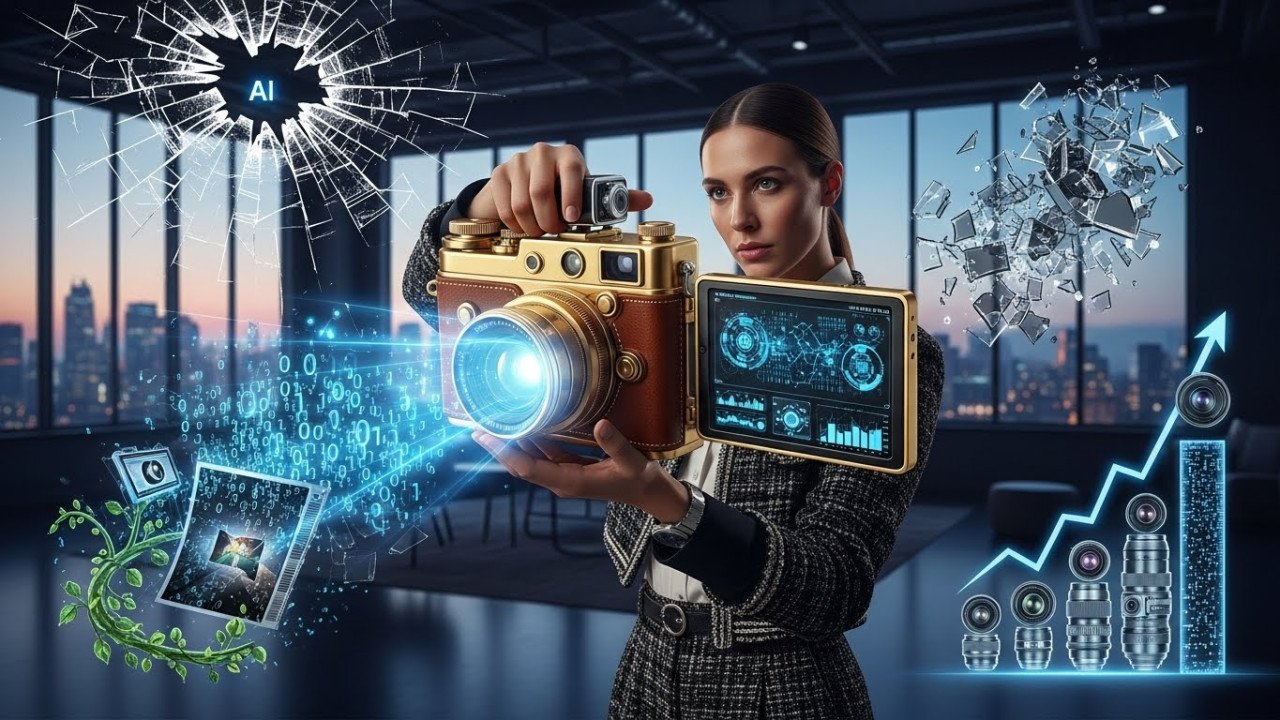
AI Photography Revolution 2026: Strategic Adaptation & Market Survival Guide
Photography Reimagined: Strategic Evolution, Market Disruption, and Professional Adaptation in the Artificial Intelligence Era
Photography stands at an unprecedented inflection point. For 185 years, the discipline remained fundamentally grounded in light, lens, and moment—the photographer's task being to capture authentic fragments of reality through technical skill, artistic vision, and decisive timing. Yet artificial intelligence is catalyzing transformation so profound that essential questions about photography's nature, value proposition, and future viability demand serious professional consideration.
The transformation isn't incremental. Within just three years, generative AI tools have advanced from novelty to capability where AI-generated images often surpass human-created alternatives for specific commercial applications. Brands increasingly deploy AI-generated models for product photography. News organizations confront deepfakes undermining photojournalism's credibility. Event photographers discover their editing time compressed from weeks to hours through AI automation. Stock photography—entire business model serving millions of photographers—faces existential disruption from systems generating unlimited images on-demand.
Yet the transformation equally represents opportunity. Photographers embracing AI as creative partner rather than threatening competitor are simultaneously eliminating tedious work and accessing creative possibilities previously impossible. The future belongs not to photographers replaced by AI, but to professionals who master AI as augmented creative extension of their vision.
This analysis examines photography's transformation across market, technological, professional, and ethical dimensions—providing frameworks for understanding where the industry is heading and how photographers can position themselves strategically within emerging reality.
The Historical Context: Photography's Previous Technological Disruptions
Photography's relationship with technological disruption extends beyond recent AI emergence. Understanding historical precedent illuminates patterns governing current transformation.
The transition from film to digital—perhaps photography's most significant previous disruption—fundamentally transformed the discipline yet generated similar apocalyptic predictions. Professional photographers in the 1990s questioned whether digital would ever match film's quality, feared the democratization enabling amateurs to compete in what had been professional domain, worried that elimination of film's economics (darkroom development, printing costs, film purchase) would destroy photography's gatekeeping professionalism.
Yet photography didn't disappear. Instead, it democratized. Barrier-to-entry collapsed. The number of people capturing images exploded. Photography became ubiquitous. Professional photographers didn't vanish; they evolved. Those adapting to digital tools, embracing new possibilities (instant feedback, infinite takes, computational editing), and understanding business transformation thrived. Those clinging to film's superiority and refusing technical adaptation faced obsolescence.
Photography's earlier history reveals consistent pattern: disruptive technology generates anxiety, enables democratization, redefines professional value proposition, and creates winners among adapters while displacing non-adapters.
Current AI transformation follows established precedent, yet with distinctions mattering profoundly. Unlike digital photography which enhanced human capability while requiring human presence and decision-making, AI offers genuine automation—the ability to generate professional-quality images without human photographer involvement. This qualitatively differs from previous disruptions where photographers remained essential agents.
The Displacement Threat: Quantifying Real Job Loss Risk
Honest assessment requires acknowledging that certain photography domains face genuine disruption from AI capability.
Stock Photography Decimation: The stock photo industry represents perhaps AI's most straightforward victim. Stock photography's entire value proposition rested on providing affordably-priced, acceptable-quality images for businesses lacking photography budgets. Microstock photography ($1-3 per image pricing) created markets for photographers generating high-volume generic content—but precisely the content generative AI excels at producing instantly.
Getty Images reported April 2025 that stock imagery licensing revenue declined 18% year-over-year as companies redirected spending toward generative AI tools. Shutterstock faced similar pressures, with comparable decline in contributor revenue. The business model sustaining millions of photographers generating acceptable-but-generic content is functionally obsolete. Companies have no rational economic reason to purchase millions of stock images annually when they can generate custom images on-demand at near-zero incremental cost.
Product and Fashion Photography Transformation: Brands increasingly recognize that AI-generated product photography, while lacking human spontaneity, offers compelling advantages: perfect lighting, infinite variations without photoshoots, rapid iteration, consistency across seasonal campaigns, and complete creative control.
Lalaland AI, Botika, and similar tools enabling AI-generated fashion models captured significant market adoption by 2025. Brands including H&M, ASOS, and smaller retailers deployed AI-generated product photography, reducing reliance on traditional product shoots. This displacement concentrated among mid-market brands where budget constraints previously justified live photography; these companies increasingly recognize that acceptable AI output exceeds their historical photography quality while offering superior economics.
Early evidence suggested mixed results. H&M faced brand backlash for AI models, criticized for lacking emotional depth and authenticity. Yet the backlash didn't prevent adoption—it merely created temporary pause as brands refined their approach. By late 2025, sophisticated AI-generated product imagery gained acceptance, particularly as brands learned to augment AI generation with selective human photography rather than replacing all professional work.
Headshot and Corporate Portrait Photography Compression: Corporate headshot photography represented another domain where AI posed direct threat. Services like StudioShot AI, Lalaland AI, and emerging competitors offered AI-generated corporate headshots at fraction of professional photography costs. While quality initially lagged human photographers significantly, rapid improvement compressed that gap.
Data suggested 23-34% decline in corporate headshot photography demand between 2023-2025 as companies discovered AI alternatives acceptable for internal directories, LinkedIn profiles, and basic corporate needs. This represented real job loss for photographers specializing in corporate photography—a segment historically providing steady income for thousands of professional photographers.
Food Photography Disruption: Food photography represented another domain where generative AI advanced rapidly. The aesthetic challenges—perfect lighting, ideal arrangement, maintaining food freshness—that made food photography technically difficult proved tractable for AI systems. By 2025, restaurants and food brands increasingly deployed AI-generated food photography for menus, promotional materials, and social media rather than investing in traditional food photography shoots.
The expansion into generative food photography displaced meaningful photography volume, affecting not just photographers but stylists, prop specialists, and the entire production infrastructure supporting food photography.
Real Job Displacement Data: Collectively, these disruptions created measurable job losses. Bureau of Labor Statistics data for photography occupations showed flat-to-declining growth rates in 2024-2025 after decades of stable employment, with particular declines in photography categories most susceptible to AI replacement.
Conservative estimates suggested 18-25% of photographers globally faced meaningful income compression by late 2025, concentrated among photographers specializing in commoditized work (stock, corporate, product) rather than artistic or specialized photography requiring human vision.
The Adaptation Opportunity: Where Photographers Thrive With AI
Simultaneously with real displacement, photographers adopting AI strategically are achieving productivity and capability advantages that strengthen their competitive positioning.
Workflow Automation and Efficiency Recovery: Photographers increasingly discover that AI-powered culling, editing, and organization tools compress post-production work by 60-85%, fundamentally transforming work-life balance.
Wedding photographers historically faced brutal workflows: shoot 8-10 hours, then spend 40+ hours editing, organizing, and color-correcting thousands of images. AI tools like Aftershoot and Imagen AI now handle bulk culling, rating, and style-consistent editing, reducing post-production to 8-12 hours—essentially eliminating the editing marathon that plagued the profession.
Aftershoot's 2025 survey of AI-adopting photographers revealed that 73% recovered meaningful work-life balance through AI adoption. Rather than editing until midnight following weekend shoots, photographers completed deliverables to clients within 48 hours, finally achieving work-life separation.
This efficiency recovery paradoxically made photography more economically viable for certain professionals. By eliminating tedious editing work, photographers could either increase income (taking additional assignments with their reclaimed time) or reduce client pricing (passing efficiency gains to customers) while maintaining margins. Both strategies strengthened competitive positioning.
Creative Enhancement and Impossible Imagery: AI simultaneously enabled creative possibilities previously impossible. Photographers increasingly used AI not merely for efficiency but for creative augmentation—generating backgrounds impossible to physically shoot, creating composite elements, exploring iterations impossible to achieve through traditional photography.
Professional photographer Erik Almas described conducting fashion shoots where he used AI to visualize background options before shooting, enabling faster on-set decisions and creative refinement impossible through traditional workflow. Rather than being threatened by AI, he positioned it as creative extension of his vision.
This creative enhancement proved particularly valuable for photographers working with limitations: limited budgets preventing expensive location travel, inability to control perfect conditions, creative vision exceeding physical possibility. AI became creative assistant enabling photographers to execute visions previously impossible within budget or logistical constraints.
Specialized Skills Retention and Deepening: Photographers who mastered specialized skills—sports photography's split-second timing, wildlife photography's field expertise, portrait photography's emotional connection, photojournalism's ethical rigor—retained substantial advantages over AI alternatives.
Data analysis revealed that AI excelled at removing skill-based friction (editing, organization, composition assistance) but struggled at capturing authentic moments requiring expertise, ethical judgment, and human connection. Professional sports photographers continued thriving not because AI couldn't generate convincing sports imagery, but because the specific moment, the genuine emotional expression, the raw authenticity of captured competition remained uniquely human domain.
Similarly, portrait photographers who cultivated genuine connection with subjects, directed authentic emotion, and created environments enabling subjects to reveal themselves rather than merely posing found their work remained in demand despite AI capabilities. The difference: they were capturing authentic human connection, not documenting appearance.
Authenticity Premium and Market Bifurcation: Perhaps most significantly, photographer adaptation manifested through authenticity positioning. As AI-generated imagery proliferated, sophisticated audiences increasingly valued authentic captured moments precisely because they proved rare and required genuine human presence.
Getty Images' 2025 survey found 98% of global consumers considered authentic imagery essential for trust-building. When asked to define authenticity, 81% responded with variations of "genuine human experience," "not AI-generated," "proof of reality." This represented genuine reversal: in an era of infinite generative possibility, authentic capture—proof that something genuinely happened—became premium commodity.
Photographers positioning themselves as "authenticity guardians" rather than competing on efficiency or capability found markets increasingly rewarding their positioning. Brands emphasizing genuine human experience in their marketing discovered authentic photography commanded premium pricing and generated superior engagement compared to generic alternatives.
The market bifurcated into two distinct segments: commodity segment (where AI displaced photographers competing on price/efficiency) and premium segment (where authentic human vision commanded premium pricing). Professional photographers who migrated upmarket found thriving opportunity.
Professional Adaptation Framework: Strategic Repositioning Across Photography Domains
Rather than universal fate, photography's future depends on domain-specific adaptation strategy.
Editorial and Photojournalism Photography
Photojournalism faces profound challenges from AI deepfakes and generative alternatives, yet simultaneously faces renewed demand for authenticity and ethical verification. Professional photojournalists who invested in:
Witness credibility through professional reputation and publication association
Verification infrastructure proving authenticity and ethical capture
Access and speed enabling on-ground reporting competitors couldn't replicate
Ethical frameworks demonstrating responsible coverage of sensitive subjects
...discovered sustainable demand despite AI threats. News organizations needed authentic capture with verified provenance more intensely than before, making professional photojournalists increasingly valuable precisely because they could prove their work's authenticity.
Commercial and Advertising Photography
Commercial photography experienced the most significant displacement. Yet photographers who adapted by:
Mastering hybrid workflow combining AI generation with selective human photography
Developing art direction expertise guiding AI toward creative vision
Building brand relationships offering complete creative solutions beyond photography
Specializing in complex shoots where human coordination and judgment proved essential
...found sustained demand. Rather than being replaced, they evolved into creative directors orchestrating hybrid workflows combining AI capability with human direction.
Portrait and Event Photography
Portrait and event photography retained strong demand precisely because of human connection requirements. Photographers who:
Prioritized genuine connection with subjects over technical perfection
Mastered directing authentic emotion rather than merely capturing appearance
Built relationship-based business models where clients valued the photographer as person
Offered complete packages mixing photography with design, presentation, printing
...weathered disruption successfully. These photographers understood their value transcended technical image capture; it involved creating experiences and facilitating genuine human connection.
Fine Art and Conceptual Photography
Fine art and conceptual photography faced minimal displacement from AI. Photographers working in conceptual traditions—exploring ideas, themes, social commentary through photographic language—found their positioning actually strengthened by AI proliferation.
As AI democratized technical capability, the photographer's unique vision became increasingly valuable precisely because skill-based commodity work became obsolete. Galleries, collectors, and art institutions increasingly valued conceptual depth and unique perspective over technical execution.
Technological Integration: From Tool to Creative Partner
The most significant transformation involves reconceptualization of AI's role from threat to creative partner.
Intelligent Culling and Organization
AI dramatically accelerated photo culling—the tedious process of selecting best shots from hundreds or thousands captured. Algorithms analyzing sharpness, composition, exposure, facial expression, and other quality metrics enabled photographers to compress curation from hours to minutes while maintaining quality standards.
Rather than manually evaluating each image, photographers set quality parameters and allowed AI to pre-sort images, enabling faster decision-making without sacrificing results. The efficiency recovery proved transformative for high-volume photographers (events, weddings, sports) whose traditional workflows centered on curation efficiency.
Intelligent Editing and Consistency
AI editing tools that learned photographer's individual style enabled consistent application across galleries of images—compressing work that previously took weeks into hours. Photographers set their stylistic preferences through feedback loops, and AI replicated their approach across entire shoots.
This proved particularly valuable for photographers whose brand depended on visual consistency. Rather than manually applying consistent editing to hundreds of images, AI learned the style and applied it automatically, enabling photographers to scale production without sacrificing consistency.
Creative Augmentation and Impossible Imagery
AI inpainting, outpainting, and generation tools enabled photographers to augment captured images with generated elements, backgrounds, or variations impossible to capture physically. This proved particularly valuable for:
Conceptual photography exploring ideas physically impractical to shoot
Composite work combining multiple captured elements with generated augmentation
Efficiency optimization generating alternatives for clients to choose from rather than conducting multiple shoots
Rather than replacing photography, these tools augmented photographic vision, enabling photographers to execute creative concepts previously impossible or prohibitively expensive.
Smart Cameras with Computational Photography
Modern smartphone and mirrorless cameras incorporated AI directly into image capture—analyzing scenes and optimizing settings, enabling face-tracking autofocus, implementing computational HDR, and offering assisted composition recommendations.
This democratized photography's technical dimension, enabling less-skilled operators to achieve professional-quality results. Yet paradoxically, this democratization strengthened professionals' advantages by freeing them from technical troubleshooting and enabling focus on creative vision and subject direction.
The Authenticity Imperative: Trust and Verification as Competitive Advantage
Perhaps the most significant strategic opportunity for photographers emerges from authenticity positioning and trust-building in an era of synthetic media.
Content Provenance and Verification
As AI-generated imagery proliferated, demand for verified authenticity increased dramatically. Getty Images, C2PA (Coalition for Content Provenance and Authenticity), and other initiatives emerged to create standards proving content origin and authenticity.
Professional photographers who positioned themselves as authenticity guardians—maintaining clear provenance, using verification technologies, communicating transparent capture processes—found competitive advantage precisely from their ability to prove genuineness.
Ethical Framework and Responsible Imagery
Beyond technical verification, photographers who developed explicit ethical frameworks around their work—transparency about AI use (when employed), responsible representation, commitment to accuracy in documentary work—built trust-based relationships with audiences and clients.
Brands increasingly recognized that authentic photography aligned with their values proved more effective than technically perfect but soulless AI-generated alternatives. Photographers who could demonstrate ethical commitment alongside creative capability found themselves positioned as brand partners rather than vendors.
AI Disclosure and Hybrid Workflow Transparency
Rather than hiding AI use, photographers who transparently communicated hybrid workflows (captured element plus AI augmentation, for example) found audiences and clients increasingly sophisticated about process transparency.
The authenticity premium didn't require photographically pure capture; it required honesty about process. Photographers communicating clearly which elements were captured versus generated versus augmented built trust through transparency rather than through technical purity.
Market Dynamics and Business Model Evolution
Photography business models underwent significant transformation, with implications for professional positioning.
Premium Positioning vs. Commodity Compression
The market bifurcated sharply. Photographers competing primarily on price and efficiency faced compression from AI alternatives offering commodity-level capability at marginal cost. Yet photographers positioning as premium providers—emphasizing unique vision, authentic connection, creative direction, ethical commitment—found their pricing power increase.
Aftershoot's 2025 survey found 70% of photographers reported client price sensitivity increased significantly. Yet simultaneously, photographers who repositioned as premium providers (rather than competing on efficiency) maintained pricing power and found demand actually increasing.
Subscription and Service Model Evolution
Rather than project-based pricing, some photographers evolved toward subscription and retainer models—positioning themselves as ongoing creative partners for brands rather than project contractors. This model proved more resistant to AI displacement because it emphasized relationship, strategy, and ongoing creative direction rather than transaction-based exchange.
Software and Tool Competency as Differentiator
Photographers who mastered not just image capture but also business AI tools (culling, editing, organization software) gained competitive advantage. Rather than differentiating on technical camera skill alone, successful photographers increasingly differentiated on comprehensive workflow mastery—understanding which tools to apply for efficiency, how to maintain quality, and how to position AI as creative enhancement rather than quality compromise.
Emerging Photography Specializations and Opportunities
New photography domains emerged specifically from AI opportunities:
Computational Photography Direction
Photography increasingly became creative direction of computational processes rather than direct capture. Photographers skilled at visual AI directing—translating creative vision into AI prompts, directing generation processes, selecting and refining generated elements—became valuable. These photographers weren't replacing traditional photography; they were creating new hybrid visual content category.
AI Training Data Collection
Photography contributed to AI training data creation—a domain that didn't exist previously. Some photographers found opportunity in careful, ethically-structured data collection for AI systems development.
Authenticity Verification and Curation
As mentioned previously, photographers positioning as authenticity guardians and curators of genuine imagery in oversaturated visual landscape found emergent opportunity.
Ethical AI Consulting
Photographers with deep understanding of both visual aesthetics and AI ethics found opportunity consulting with organizations navigating responsible AI imagery deployment.
Frequently Asked Questions: Professional Adaptation and Strategic Positioning
Will AI completely eliminate photography as profession?
No. AI will displace commodity photography (stock, corporate headshots, generic product shots) but cannot replace human vision, connection, and authentic capture. Professional photographers will survive, but positioned differently—emphasizing uniqueness rather than technical perfection.
Should photographers embrace or resist AI?
Embrace strategically. Resist only specific applications conflicting with your professional positioning (e.g., photojournalists refusing AI use for ethical reasons). Most photographers benefit from AI adoption for workflow efficiency and creative enhancement.
Which photography domains face greatest displacement?
Stock photography, commodity product shots, and corporate headshots face greatest disruption. Fine art, editorial, specialized (sports, wildlife), and authentic human portraiture face minimal displacement.
How should photographers position themselves competitively?
Move away from commodity competition. Emphasize unique vision, authentic human connection, specialized expertise, ethical commitment, or creative direction. Differentiate on value beyond technical image capture.
What skills remain valuable?
Human connection, creative vision, subject expertise, ethical judgment, directing authentic emotion, understanding brand strategy. Technical camera skill becomes less valuable as AI handles technical optimization.
How do I transition if my photography currently focuses on AI-threatened domains?
Gradually migrate toward premium positioning, develop specialization, emphasize authentic capture, or evolve toward creative direction and strategic consulting roles. The transition requires strategic thinking beyond current workflow.
Are there ethical concerns I should consider?
Yes. Consider authenticity commitment, responsible AI use, transparency about process, fair representation, and ethical implications of your work. These become competitive advantages as consumers increasingly value ethical practice.
What should I invest in learning?
Workflow efficiency tools, business AI capabilities, creative AI augmentation, authenticity frameworks, ethical reasoning, and creative direction skill. Less valuable: purely technical camera mastery that AI now handles effectively.

Comments (0)
No comments found