


AI-Driven Business Strategies 2026: Ultimate Blueprint for Profitable Revenue
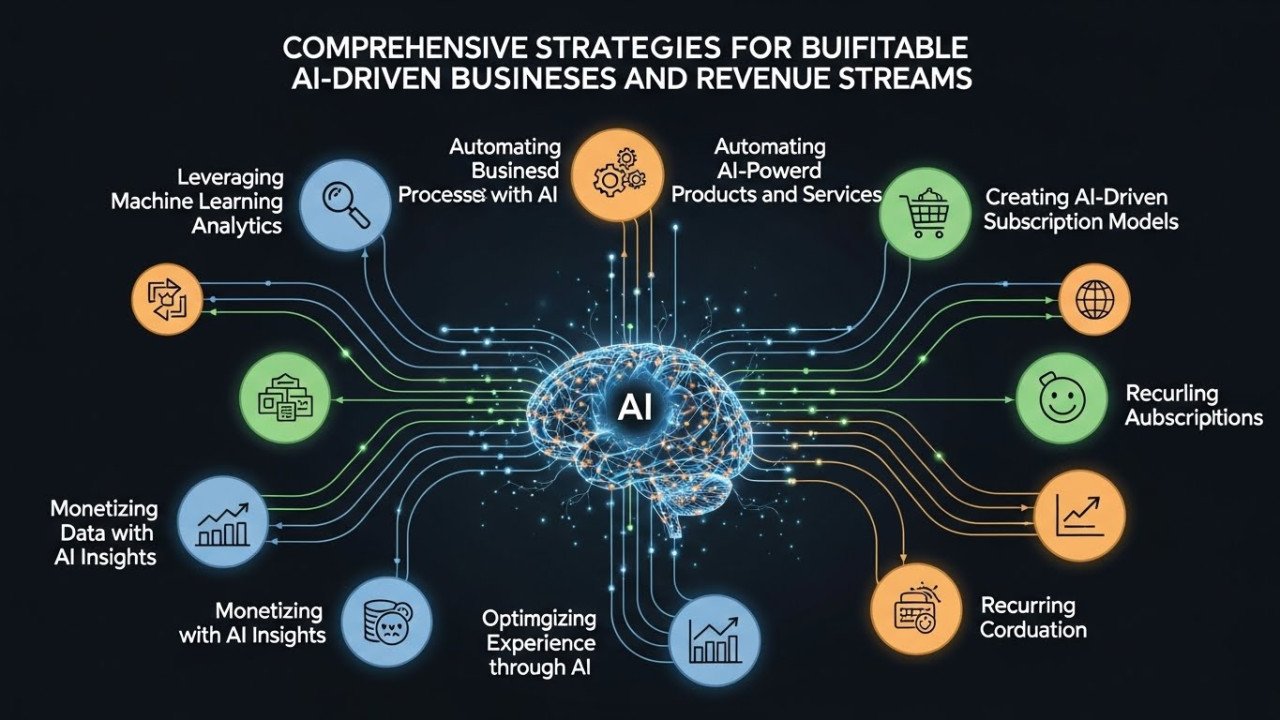
Capitalizing on Artificial Intelligence: Comprehensive Strategies for Building Profitable AI-Driven Businesses and Revenue Streams
The artificial intelligence revolution presents unprecedented opportunities for entrepreneurs, freelancers, and established businesses to create substantial, scalable revenue streams by developing AI-powered products, services, and content. As organizations increasingly adopt generative AI technologies and integrate them into operations, demand for specialized AI services, solutions, and expertise continues accelerating—creating market windows for first-movers and well-positioned players. The global AI market has expanded explosively, with McKinsey research estimating that generative AI alone could add $2.6 trillion to $4.4 trillion in annual value across identified use cases, representing a 15-40 percent increase in the total economic impact of all artificial intelligence. This economic transformation creates tangible opportunities for entrepreneurs willing to understand market dynamics, build quality solutions, and execute disciplined go-to-market strategies.
However, success in AI monetization requires moving beyond AI hype to focus on genuine value creation for customers. Research indicates that 95 percent of organizations report no or very limited returns from internal generative AI pilots, suggesting that simply deploying AI tools without clear business logic and customer value proposition fails to generate sustainable returns. The most successful AI businesses solve specific, well-defined customer problems through intelligent automation, superior analytics, or enhanced user experiences—not by layering AI onto existing products without clear justification. Understanding both the technical capabilities of AI systems and the business dynamics of different market segments is essential for entrepreneurs seeking to build durable, profitable ventures.
Service-Based AI Businesses: Trading Expertise for Premium Pricing
AI-Enhanced Professional Services
One of the most accessible pathways to AI monetization involves leveraging AI tools to enhance existing professional services, allowing service providers to work faster, deliver higher quality, and serve more clients than competitors still using traditional methods. AI content marketing agencies exemplify this approach: they use generative AI to draft blog posts, social media content, email campaigns, and ad copy, then apply human expertise to refine, contextualize, and ensure brand alignment. The competitive advantage flows from dramatically reduced production time—what might require days of human writing can be drafted in hours—enabling agencies to serve more clients profitably or produce higher volume for existing clients.
Similarly, AI-powered graphic design services deployed through platforms like Fiverr enable designers to generate initial concept variations using AI image generators, then apply their aesthetic judgment and design expertise to refine, combine, and finalize outputs. This hybrid approach accelerates delivery timelines from weeks to days while maintaining the creative control and quality that clients expect. Clients perceive value in faster turnaround and lower costs, while designers capture productivity gains as profit margin—an attractive value proposition for both parties.
The key success factor in AI-enhanced services is maintaining honest communication about AI involvement while emphasizing the human expertise applied afterward. Clients increasingly expect transparency about AI use; research shows that consumers react negatively to discovered undisclosed AI involvement, but accept AI-assisted services when clearly communicated and combined with genuine human expertise. The most sustainable service businesses position AI as an efficiency multiplier amplifying human skill rather than replacing it.
Freelance platforms including Fiverr, Upwork, and Freelancer.com have emerged as viable marketplaces for AI-enhanced services, particularly for service providers establishing initial credibility or pursuing higher-volume, lower-complexity work. Fiverr's dedicated "AI Services" section (launched in 2024) now features over 3,000 AI-related gigs across content creation, design, development, and marketing categories, demonstrating substantial market demand. Success on these platforms typically requires building strong initial reviews through quality work, competitive pricing on early projects, and then gradually raising rates as reputation and demand increase.
AI Consulting and Implementation Services
As organizations navigate AI adoption complexity—selecting appropriate tools, implementing systems responsibly, and managing organizational change—AI consulting and implementation services emerge as high-value business opportunities. AI consultants advise organizations on strategy, vendor selection, implementation planning, risk management, and ROI maximization, commanding premium pricing because they reduce client risk and accelerate value realization.
The most valuable consultants combine deep understanding of specific industries with practical AI deployment experience. A healthcare consultant advising hospital networks on AI diagnostics systems, clinical decision support implementation, and vendor negotiations brings industry context that generic technology consultants lack. Similarly, financial services consultants guide institutions through AI implementation for fraud detection, customer service, and risk analysis, addressing sector-specific regulatory, compliance, and governance requirements.
Success in AI consulting typically requires establishing credibility through demonstrated expertise, publications, conference presentations, or previous consulting engagements. Early-career consultants often build credibility through fractional roles (part-time consulting while maintaining primary employment), case studies demonstrating measurable client impact, and strategic networking within target industries.
Platform-Based AI Businesses: Building Scalable SaaS Solutions
Vertical SaaS Targeting Industry-Specific Problems
While horizontal AI platforms (serving multiple industries with general-purpose tools) face intense competition from well-funded technology companies, vertical SaaS solutions targeting specific industries with tailored AI capabilities remain attractive opportunities. These solutions combine domain expertise with AI technology to solve industry-specific problems that horizontal solutions address inadequately.
AI-powered recruitment tools exemplify this category: they use AI to screen resumes, assess candidate qualifications against job requirements, predict cultural fit, and identify top candidates for interviews—accelerating hiring while improving quality. The vertical positioning allows developers to optimize for HR workflows, compliance requirements specific to employment law, and terminology reflecting recruitment industry practices. A recruitment AI platform can command pricing 2-3 times higher than a generic document-screening tool because it delivers recruitment-specific value.
Other attractive vertical opportunities include:
AI-powered healthcare diagnostics and administrative tools: Combining AI with clinical knowledge for diagnostics support, patient triage, medical coding automation, and billing optimization. Healthcare's regulatory complexity, high stakes, and premium pricing power create attractive business conditions for focused solutions.
Financial services AI: Solutions for loan underwriting automation, fraud detection, customer service chatbots, and algorithmic trading support where AI's accuracy and speed directly translate to financial value.
Supply chain optimization: AI systems predicting demand, optimizing inventory, scheduling production, and routing logistics—addressing a critical challenge for retail, manufacturing, and distribution companies.
Sales enablement and revenue operations: AI tools analyzing sales data, scoring leads, recommending next actions, and coaching sales representatives—segments experiencing strong demand as organizations prioritize revenue growth.
The path to vertical SaaS success typically begins with founders identifying their industry expertise, pinpointing a high-value problem inadequately addressed by existing solutions, building an MVP (minimum viable product) addressing that specific problem, and then selling directly to companies in that vertical. Early customers become references for subsequent sales, creating compounding advantages as product-market fit strengthens.
AI Data Analytics and Business Intelligence Platforms
AI-powered data analytics and business intelligence platforms help organizations extract actionable insights from data through automated analysis, predictive modeling, and visualization—work that typically requires data scientists or analysts. The market opportunity is substantial: 58 percent of small-to-medium businesses seek AI analytics tools in 2025, indicating strong demand for solutions balancing sophistication with accessibility.
These platforms create value through:
Automated data processing: Cleaning, transforming, and consolidating data from multiple sources without manual intervention.
Predictive analytics: Identifying patterns and forecasting future trends (customer churn, demand spikes, anomalies) that enable proactive decision-making.
Anomaly detection: Automatically identifying unusual patterns that might indicate problems (fraud, quality issues, security threats) requiring investigation.
Natural language interfaces: Enabling non-technical users to query data conversationally, dramatically expanding who can access insights.
McKinsey analysis suggests that organizations applying AI analytics to customer operations could increase productivity by 30-45 percent of current function costs, creating quantifiable ROI that justifies investment. This strong business case supports premium pricing (typically $1,000-$50,000+ annually depending on data volume and complexity) and facilitates customer acquisition.
The competitive challenge involves balancing sophistication with usability: solutions that are too complex require technical expertise that small businesses lack, while overly simplified solutions fail to deliver the analytical depth larger organizations need. Successful platforms typically start with specific use cases (churn prediction for SaaS companies, demand forecasting for retailers) where both problem definition and success metrics are clear, then gradually expand to adjacent use cases.
Content Creation Monetization: Leveraging AI for Digital Media Revenue
AI-Generated YouTube Videos and Content Monetization
YouTube presents an attractive monetization opportunity for creators willing to leverage AI video generation tools to dramatically increase production volume while maintaining quality standards. AI video generators like Synthesia, HeyGen, and DeepBrain compress video production timelines from weeks to hours, enabling creators to generate substantially more content than competitors still using traditional production methods. The economic case is compelling: creators producing 10-15 videos monthly through traditional filming and editing might generate 4-8 videos monthly through AI tools without sacrificing content quality—doubling output while potentially reducing production costs.
The critical requirement for monetization involves demonstrating "significant added value" beyond raw AI output—a requirement YouTube formalized in updated policies addressing AI-generated content. This means:
Educational or commentary context: Narrating content in your unique voice, providing analysis or expertise that transforms raw AI output into valuable information.
Original creative direction: Making meaningful creative decisions about content structure, visual style, and narrative approach rather than simply running prompts and publishing results.
Curation and combination: Selecting from multiple AI-generated options, combining elements, and applying editorial judgment that reflects your creative vision.
Transparency about AI involvement: If your video includes synthetic voices, AI-generated realistic content, or AI avatars of real people, YouTube requires disclosure in the video description.
Successful AI-content creators report monthly earnings ranging from $500 (channels with 10,000-50,000 subscribers) to $5,000-$50,000 (channels with 100,000+ subscribers and strong audience engagement). The YouTube Partner Program requires 1,000 subscribers and 4,000 watch hours annually before monetization eligibility, a threshold achievable within 6-12 months for creators producing quality, niche-focused content regularly.
Diversifying revenue beyond YouTube ads is particularly important given YouTube's declining CPM (cost per thousand impressions) rates. Successful creators combine:
YouTube ad revenue through the Partner Program
Affiliate marketing: Recommending products and earning commissions when viewers purchase through affiliate links
Sponsorships: Partnering with brands to feature products or services in videos, earning fixed fees per video
Patreon or channel memberships: Offering exclusive content to supporters who pay monthly fees
A creator producing 20 videos monthly could reasonably generate $2,000-$10,000 in combined revenue depending on audience size, niche selection, and monetization diversification—creating viable supplementary income or full-time career depending on content production rate and audience engagement.
AI-Powered Content Creation for Product Listings and E-Commerce
E-commerce businesses require substantial content—product descriptions, category copy, marketing emails, advertising headlines—that directly impacts conversion rates and customer acquisition costs. AI content generation for e-commerce enables product-focused businesses to scale content production dramatically while maintaining quality.
A retailer with 1,000 products might require updating descriptions quarterly due to seasonal changes, inventory adjustments, or marketing repositioning. Traditional copywriting at $50-$100 per product description could cost $50,000-$100,000 quarterly—economically impractical for most businesses. AI-assisted content generation reduces this cost to $5,000-$10,000 while maintaining quality by combining AI drafting with human refinement.
The monetization path involves:
Direct service provision: Offering product description writing, category optimization, and marketing copy creation to e-commerce businesses through freelance platforms or direct outreach. Pricing typically ranges from $500-$2,000 per project (50-100 products) or monthly retainers of $1,000-$5,000.
Building AI-as-a-service tools: Creating platforms that allow retailers to input product information and automatically generate optimized copy, enabling higher-volume, lower-friction monetization. These platforms typically use subscription pricing ($99-$500 monthly) with tiers reflecting content volume and feature sophistication.
Content creation agencies: Positioning as an e-commerce content partner, taking responsibility for ongoing product description optimization, category messaging, and marketing copy creation. Monthly retainers typically range from $2,000-$10,000 depending on product volume and content complexity.
The economic logic is compelling: improved product descriptions demonstrably increase conversion rates by 10-20 percent, and marketing copy optimization can reduce customer acquisition cost by similar magnitudes. This translates to thousands of dollars in additional revenue for retailers—making content optimization investments highly attractive from their perspective.
Online Courses and AI-Enhanced Educational Content
The online education market exceeded $185 billion in 2023 and is projected to reach $257 billion by 2028, growing at approximately 40 percent annually. This explosive growth reflects both demand from individual learners seeking affordable, accessible education and corporate investment in employee training. AI dramatically accelerates course creation by automating content synthesis, generating interactive exercises, producing multimedia assets, and personalizing learning experiences.
Building and selling online courses represents an accessible monetization path with demonstrated income potential. Course creators report earnings between $1,000-$5,000 monthly on average, with successful top-tier creators generating $100,000+ annually. The path involves:
Identifying a marketable niche: High-value topics (software development, business strategy, digital marketing) command premium pricing and attract more buyers than hobby or lifestyle courses.
Leveraging AI for content production: Using AI to draft lesson scripts, generate visual assets, create interactive quizzes, and synthesize supplementary materials. AI dramatically reduces production time from weeks to days while enabling personalization through adaptive learning systems.
Selecting the right platform: Udemy offers the largest built-in audience but takes substantial commission (50-70 percent of revenue), while Teachable, Thinkific, and self-hosted options provide more control over pricing and student data at the cost of requiring personal marketing.
Implementing effective marketing: Course success depends primarily on marketing effectiveness—through email lists, social media, affiliate partnerships, and paid advertising. Most successful creators invest 50 percent of effort in course content and 50 percent in marketing.
The financial model works through volume: a $47 course generating 100 monthly sales produces $4,700 in gross revenue (before platform fees), $2,800+ net. Scaling to multiple courses addressing related topics or audience segments can compound income substantially.
Direct AI Product Monetization: Pricing Strategies and Models
Subscription-Based SaaS Models
Subscription pricing has emerged as the dominant monetization model for AI-powered software, providing predictable recurring revenue and aligning vendor incentives with ongoing customer success. SaaS businesses with strong AI capabilities report retaining 90+ percent of customers annually when delivering consistent value, creating compounding revenue growth.
The most successful subscription models combine:
Tiered pricing: Offering multiple tiers (Starter, Professional, Enterprise) with increasing features, usage allowances, or support levels. This captures different customer segments' willingness to pay while encouraging upgrades as organizations grow.
Usage-based components: Combining base subscription pricing with usage charges reflecting consumption (API calls, data processed, models trained, outputs generated). This aligns costs with value delivered while removing price ceilings on customer expansion.
Value-based pricing: Setting subscription prices reflecting actual value delivered to customers rather than cost-plus markup. An AI system increasing sales productivity by $100,000 annually justifies $10,000-$30,000 annual subscription pricing.
Research indicates that companies aligning AI pricing with consumption patterns and perceived value achieve double the revenue growth of competitors maintaining flat-rate pricing. This suggests that thoughtful pricing strategy represents a substantial competitive advantage in AI monetization.
Freemium Models and Premium Upgrades
Freemium models—offering core functionality free while charging for premium features—have proven highly effective for certain AI applications, particularly consumer-focused tools and vertical marketplaces. Freemium models typically convert 2-5 percent of free users to paid plans in B2B contexts and higher percentages in consumer categories.
The economics work through:
Free tier acquisition: Attracting users with free basic functionality, building large user bases that can be monetized across various channels.
Natural upgrade triggers: Identifying features or usage thresholds where premium features provide obvious value (storage limits, processing speed, advanced analytics), creating natural upgrade incentives.
Demonstrating premium value: Ensuring free tier users experience clear limitations that premium tiers address, making upgrade decisions obvious rather than aspirational.
GitHub Copilot (free individual tier with $10/month paid access), Perplexity AI (free with optional Pro subscription), and numerous AI content generators use freemium models successfully. The model works best for applications with clear free/premium differentiators and where free users create network effects or data that improves paid product quality.
Marketplace Transaction Models
AI marketplaces connecting buyers and sellers of AI services, models, or data generate revenue through transaction fees, listing charges, and premium placement options. Fiverr's AI Services marketplace exemplifies this approach, charging both buyer and seller transaction fees (typically 5-30 percent depending on transaction size) on thousands of AI service transactions.
The marketplace model creates value through:
Reducing friction: Providing trusted platforms where buyers can discover and purchase AI services without complex sales processes.
Standardizing quality: Implementing review systems, ratings, and dispute resolution that reduce buyer risk and encourage transactions.
Volume economics: Charging small percentages on high transaction volumes generates substantial revenue without individual pricing negotiations.
The challenge involves achieving critical mass: marketplaces require sufficient supply (service providers) and demand (buyers) to function effectively, creating chicken-and-egg dynamics that make early-stage marketplace growth difficult. Successful marketplaces typically focus initially on specific niches (AI services for e-commerce, AI development tools for startups) where concentrating supply and demand achieves critical mass.
Emerging Opportunities and Growing Market Segments
AI-Powered Personalization and Customer Experience
Personalization represents one of the highest-value applications of generative AI, with McKinsey research estimating that generative AI could deliver 5-15 percent productivity improvements in marketing through personalized content creation and customer targeting. AI personalization engines helping retailers, publishers, and service companies deliver individualized customer experiences command premium pricing because personalization directly drives revenue.
These systems use AI to:
Segment audiences: Identifying customer clusters with similar preferences, purchasing patterns, and engagement behaviors.
Generate personalized content: Creating tailored product recommendations, marketing messages, and user experiences for each segment.
Optimize timing and channels: Determining when and through which channels (email, SMS, app, web) each customer is most likely to engage.
Predict lifetime value: Identifying high-value customers warranting premium service or retention investment.
Retailers implementing AI-powered personalization report 10-20 percent conversion rate improvements, 15-25 percent increases in customer lifetime value, and 20-30 percent reductions in customer acquisition costs. These improvements create substantial business case for investment, supporting premium pricing for personalization platforms.
Healthcare and Specialized Industry AI
Healthcare remains one of the highest-value application areas for AI due to premium pricing power, regulatory complexity preventing commoditization, and substantial economic value of improved outcomes. Healthcare AI businesses addressing diagnostics support, clinical documentation, patient management, and operational efficiency face less competition than consumer-focused AI businesses and can command pricing reflecting their value.
The regulatory and compliance requirements actually create competitive moats protecting healthcare AI businesses from commoditization: new entrants must navigate medical device regulations, healthcare privacy laws, clinical validation requirements, and integration with existing healthcare IT infrastructure. These barriers increase time-to-market and complexity, enabling well-positioned healthcare AI businesses to establish strong market positions.
Similarly, financial services AI (fraud detection, underwriting automation, algorithmic trading) benefits from regulatory compliance requirements and premium pricing justified by financial institutions' risk management imperatives.
Avoiding Common AI Monetization Mistakes
The Value Creation Imperative
The most critical mistake in AI monetization involves assuming that merely deploying AI technology creates value—a fallacy evident in widespread underperformance of organizational AI pilots. Building successful AI businesses requires clearly articulating what customer problem is being solved, why existing alternatives are inadequate, and what measurable improvements the AI solution delivers.
Successful AI businesses obsess over customer outcomes and value delivery, not technology capabilities. This customer-centric focus shapes product development, pricing strategy, and go-to-market approach.
Avoiding Commoditization Through Specialization
Businesses attempting to build general-purpose, horizontal AI solutions face intense competition from well-funded technology giants with superior resources, existing customer relationships, and technological capabilities. Succeeding in AI typically requires specialization—either industry focus (healthcare, finance, supply chain) or specific use cases (lead scoring, customer churn prediction, fraud detection) where deep expertise and customization matter.
Honest Pricing and Sustainable Unit Economics
Many AI businesses have attempted unsustainably low pricing to drive adoption, only to discover that unit economics don't support scaling, customer acquisition costs exceed lifetime value, or competitive price wars destroy margins. Sustainable AI businesses establish pricing reflecting genuine customer value while maintaining unit economics enabling reinvestment.
Conclusion: The AI Monetization Window
The convergence of advancing AI capabilities, rapidly growing adoption by organizations and individuals, and substantial economic value creation by AI applications creates an extraordinary window for entrepreneurs building AI-powered businesses and monetizing AI capabilities. The most successful participants recognize that AI is not an endpoint but a tool—valuable only when focused on creating genuine customer value and solving well-defined problems better than existing alternatives.
Whether pursuing service-based businesses leveraging AI to amplify human expertise, building vertical SaaS solutions addressing industry-specific challenges, creating content monetized across multiple channels, or developing consumer applications benefiting from personalization and automation, the fundamental principles remain constant: focus relentlessly on customer value, establish sustainable unit economics, differentiate through specialization and depth rather than horizontality, and execute disciplined go-to-market strategies. Entrepreneurs and businesses applying these principles to their AI ventures position themselves to capture substantial value from the AI transformation reshaping every industry and market segment.





Comments (0)
No comments found