


AI Marketing Strategy 2025: The Ultimate Integration Framework for Digital Success
Transforming Marketing Strategy Through Artificial Intelligence: Comprehensive Integration Framework for Digital Success in 2025
The marketing industry stands at an inflection point where artificial intelligence has transitioned from emerging opportunity to operational necessity—fundamentally redefining how businesses understand customers, create content, allocate budgets, and measure results. The statistical evidence is compelling: organizations strategically implementing AI across marketing operations report 25-30 percent improvements in ROI, 2 times higher customer engagement rates, 1.7 times higher conversion rates, 28 percent reductions in customer churn, and up to 50 times faster content development cycles compared to manual approaches. Yet despite these documented benefits, most marketing organizations remain in early experimentation phases—conducting isolated pilots, testing individual tools, and approaching AI adoption reactively rather than systematically integrating AI into core marketing strategy, people, processes, and technology infrastructure.
The transformation required goes beyond tool adoption: organizations must fundamentally reimagine their marketing operating models around AI capabilities, data infrastructure, and new ways of working that balance algorithmic optimization with human creativity, strategic judgment, and brand authenticity. The most successful 2025 marketing strategies recognize that AI is not a replacement for marketing expertise but rather a force multiplier enabling marketers to operate at unprecedented scale, precision, and speed while focusing human effort on strategy, creativity, and relationship-building. This comprehensive guide addresses the strategic frameworks, operational transformation, technology integration, and organizational capabilities enabling marketing leaders to navigate AI integration systematically, avoiding common pitfalls while capturing genuine competitive advantage.
Strategic Framework: Where AI Creates Marketing Value
The AI-Enabled Marketing Value Chain
Understanding where AI creates disproportionate value enables strategic prioritization preventing implementation chaos:
Market Insight and Customer Understanding (High Value)
AI dramatically accelerates market research and customer intelligence generation. Rather than traditional research consuming weeks and generating static reports, AI processes massive datasets in hours, identifying emerging trends, competitive positioning, and customer sentiment continuously. Predictive analytics anticipate what customers will want before they recognize the need themselves, enabling proactive strategy rather than reactive market response. This insight foundation enables every subsequent marketing activity—targeting precision, messaging resonance, and channel strategy all improve with deeper, more current customer understanding.
Audience Segmentation and Targeting (High Value)
Traditional demographic segmentation divides audiences into broad groups; AI segmentation operates at "markets of one" scale, identifying micro-segments with similar behaviors, preferences, and purchase patterns enabling hyper-targeted messaging. Machine learning continuously refines segmentation as new data arrives, enabling dynamic targeting that improves continuously rather than quarterly. The result is messaging reaching precisely the right audience at optimal timing with offers matching their specific preferences and willingness-to-pay.
Content Creation and Optimization (Medium-High Value)
AI dramatically accelerates content production—generating ideas, drafting copy, optimizing headlines, creating variations for A/B testing—while freeing human creativity to focus on strategy, brand voice, and breakthrough thinking. However, AI-generated content alone lacks distinctive voice and authentic perspective that build brand differentiation. The highest value emerges from human-AI partnership: AI generates variations and optimization suggestions; humans apply judgment, creativity, and brand voice.
Campaign Activation and Personalization (High Value)
AI automates campaign setup, intelligently allocates budgets across channels, optimizes delivery timing, and personalizes creative by audience segment at scale impossible manually. Dynamic pricing adjusted by demand, inventory, and competitive factors maximizes revenue; next-best-action recommendation engines suggest most valuable offers for each customer. The automation frees marketing teams from operational drudgery while personalization increases conversion rates substantially.
Predictive Analytics and Performance Forecasting (Medium Value)
Rather than waiting for campaigns to complete to measure results, AI predicts likely performance enabling real-time optimization. Propensity models forecast which customers are most likely to convert, churn, or purchase high-margin products, enabling prioritization of marketing investment. These predictive capabilities enable proactive marketing intervention—reaching high-churn-risk customers with retention offers before they leave—rather than pure responsiveness.
Measurement and Attribution (Medium Value)
AI simplifies marketing measurement challenges: multi-touch attribution tracks which touchpoints contributed to conversions; media mix modeling optimizes budget allocation across channels; marketing analytics dashboards surface insights automatically rather than requiring manual reporting. The result is clearer visibility into marketing effectiveness and ROI despite fragmented customer journeys across multiple channels.
Influencer Identification and Partnership Management (Low-Medium Value)
AI identifies influencers matching brand positioning, analyzes their audience quality, predicts partnership likely success, and automates outreach to potential partners. Partnership management automation tracks campaign performance and suggests collaboration ideas. While valuable, this application remains relatively narrow compared to core customer-facing applications.
Operational Integration: From Silos to AI-Native Marketing Functions
Reorganizing Around AI Capabilities
Rather than bolting AI onto existing marketing structures, successful transformation requires reimagining functions and workflows around AI capabilities:
Customer Data Platform (CDP) as Foundation
AI marketing effectiveness depends fundamentally on high-quality, unified customer data. A modern CDP consolidates data from all customer touchpoints—website, email, paid advertising, social, CRM, transaction systems—into single customer profiles enabling 360-degree understanding. Without this data foundation, AI operates with incomplete information, producing suboptimal targeting and personalization.
Implementation priorities include: establishing single customer view through identity resolution; consolidating disparate data sources into unified platform; implementing data governance ensuring quality, accuracy, and privacy compliance; and enabling real-time data activation enabling immediate personalization decisions.
Predictive and Prescriptive Analytics Functions
Rather than historical reporting, modern marketing organizations employ data scientists building predictive models—propensity models, churn prediction, customer lifetime value forecasting, next-best-action recommendation—that enable strategic decisions with future-oriented insights. These functions require deeper technical capability than traditional marketing analytics, necessitating either hiring data science talent or partnering with specialized vendors.
AI-Native Content Operations
Traditional content workflows—brief creation, ideation, drafting, editing, approval, publication—serialize activities requiring weeks from concept to publication. AI-native content operations parallelize processes: AI generates multiple variations simultaneously; content creators focus on strategy and voice rather than initial drafting; approval workflows optimize for quality review rather than creative generation. The European telecom case study exemplifies this: gen AI enabled 50 times faster content development by automating brainstorming, copy generation, and versioning.
Key transitions include: deploying AI writing tools (Jasper, Copy.ai, ChatGPT) enabling rapid initial drafting; implementing brand voice guardrails ensuring consistency; establishing content data management capturing metadata, performance data, and learnings systematically; and shifting content team roles from creation toward strategy and curation.
Programmatic Marketing at Scale
Programmatic advertising—automated, data-driven ad buying—remains underutilized by most marketing organizations despite extraordinary efficiency potential. Value-based bidding (bidding higher for high-value customer segments) combined with broad keyword matching, audience targeting, and creative optimization delivers dramatic improvement: Intuit QuickBooks achieved 45 percent annual customer acquisition growth while reducing costs through AI-powered Search advertising.
Programmatic extends beyond paid search to email marketing (sending optimal frequency and timing by individual), social advertising (testing thousands of creative variations by audience segment), and even programmatic direct (DOOH) advertising.
Marketing Measurement Infrastructure
Traditional marketing measurement suffers from attribution challenges (crediting which touchpoint deserves credit for conversion), channel fragmentation (different tools, different data), and privacy limitations (third-party cookie deprecation). AI addresses these challenges through: multi-touch attribution models tracking contribution of each touchpoint; media mix modeling optimizing budget allocation across channels; incrementality testing isolating true causal impact versus correlation; and first-party data activation maximizing privacy-compliant personalization.
Implementation requires: establishing measurement strategy before launching campaigns; implementing tracking and data infrastructure enabling attribution; deploying analytics platforms consolidating results; and establishing governance ensuring consistency in metrics and definitions.
Organizational Restructuring and Capability Building
Beyond functional reorganization, successful AI integration requires organizational changes:
Cross-Functional Collaboration
AI-driven marketing demands collaboration between traditional marketing, data science, engineering, and IT—groups historically operating in silos. Breaking down silos requires: establishing shared objectives and incentives, shared accountability; creating cross-functional project teams; establishing data governance forums; and developing shared language and understanding.
Balancing AI Optimization with Human Judgment
The most common failure mode involves over-trusting AI recommendations, allowing algorithmic optimization to dominate decisions at cost of brand judgment, creative differentiation, and values-based strategy. Successful organizations establish clear governance: AI recommends, humans decide on high-stakes choices; AI optimizes within human-established guardrails; humans maintain authority over brand-defining decisions.
Continuous Learning and Skill Development
AI transforms marketing faster than most organizations can train people. Building capabilities requires: ongoing training on AI tools and capabilities; developing data literacy ensuring all marketers understand what data means and how to interpret it; establishing communities of practice sharing learnings; and recruiting technical talent with data science and engineering capabilities.
Technology Architecture: Building AI Marketing Stack
Core Technology Components
Customer Data Platform (CDP)
CDP consolidates data from all customer touchpoints into unified profiles enabling 360-degree customer understanding. Implementations should prioritize: identity resolution (connecting customer interactions across devices, touchpoints); real-time data ingestion and activation; segmentation and audience building; and privacy compliance. Leading CDPs include Segment, mParticle, Tealium, and Lytics.
Marketing Automation and Personalization Platform
Platforms like HubSpot, Marketo, Salesforce Marketing Cloud, Adobe Experience Platform orchestrate multi-channel campaigns with AI-driven personalization, email optimization, journey orchestration, and workflow automation. These platforms should integrate with CDP, AI content tools, analytics systems, and channel platforms (email, SMS, paid advertising, social).
AI-Powered Content and Creative Tools
Generative AI tools dramatically accelerate content production while enabling personalization at scale. Strategic tools include:
Copy AI, Jasper, ChatGPT: General content generation for copy, email, social posts, landing pages
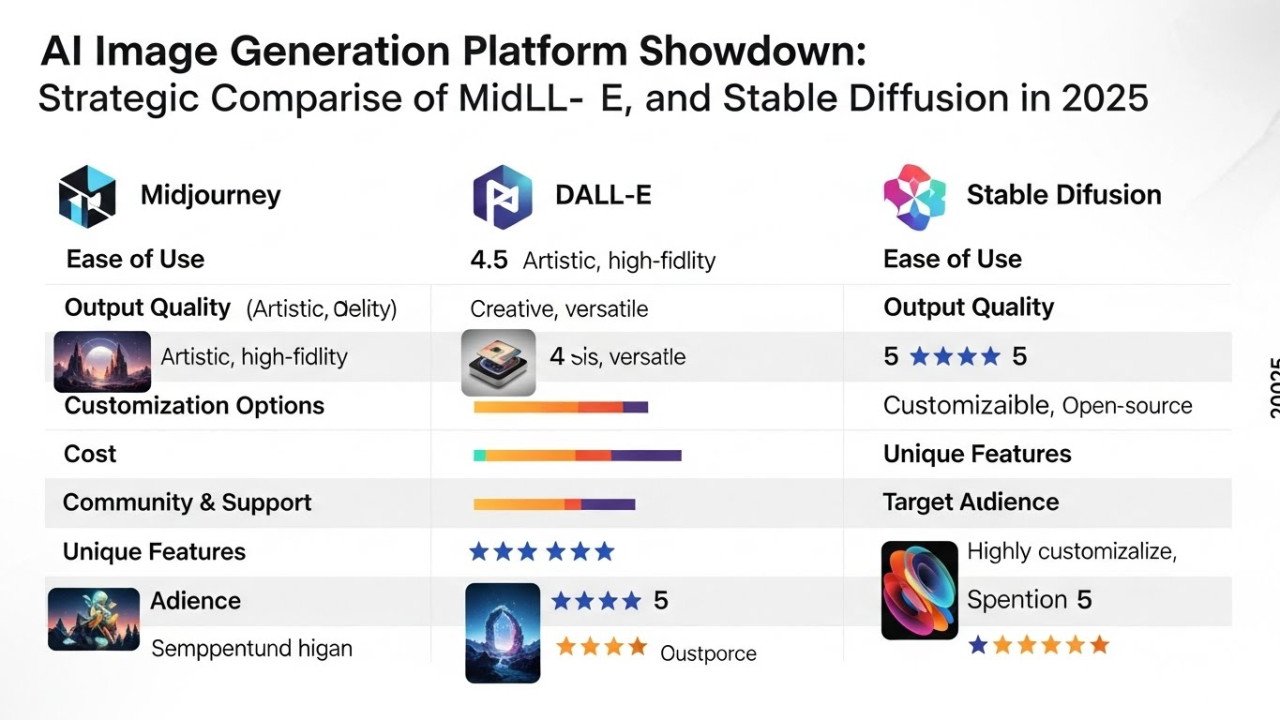
Midjourney, DALL-E, Canva AI: Visual content and design variation generation
Synthesia, HeyGen: Video content generation enabling scalable video personalization
SEO AI tools (Surfer SEO, Outrank, NeuronWriter): Content optimization for search
Analytics and Measurement
Platforms providing predictive modeling, attribution analysis, marketing mix modeling, and performance dashboards include: Mixpanel, Amplitude (product analytics), SQL-based data warehouses (Snowflake, BigQuery), business intelligence tools (Tableau, Power BI), and specialized marketing analytics (Measured, Contentsquare).
Paid Advertising Platforms
Google Ads, Facebook Ads, LinkedIn Ads increasingly incorporate AI: automated bidding strategies (value-based bidding, maximize conversion value), audience targeting (lookalike audiences, custom audiences), creative automation (responsive display ads, dynamic creative optimization), and campaign setup automation.
Integration and Orchestration
Modern marketing stacks require integration enabling data flow between systems. APIs, middleware platforms (Zapier, Make), and native integrations connect systems: CDP to marketing automation; marketing automation to paid advertising; CRM to analytics; content tools to publishing systems.
Technology Implementation Phasing
Rather than attempting complete technology transformation simultaneously, phased implementation reduces risk and enables learning:
Phase 1 (Months 1-3): Foundation
Implement or audit CDP for data consolidation capability
Deploy analytics infrastructure for measurement (Google Analytics 4, DW setup)
Select marketing automation platform (if not already in place)
Establish data governance and privacy framework
Phase 2 (Months 4-6): Core AI Capabilities
Implement customer segmentation and targeting using ML
Deploy email marketing automation with predictive send-time optimization
Activate first personalization use cases (product recommendations, dynamic email content)
Launch predictive analytics initiatives (churn prediction, LTV forecasting)
Phase 3 (Months 7-12): Advanced and Content Scale
Deploy generative AI for content creation at scale
Implement programmatic advertising optimization
Build next-best-action recommendation engines
Expand personalization across channels and touchpoints
Phase 4 (Year 2+): Autonomous Marketing
Implement full-funnel marketing orchestration
Deploy advanced AI-driven optimization (budget allocation, creative optimization, pricing)
Build self-learning systems that continuously improve without manual intervention
Integrate emerging AI capabilities as available
Practical AI Applications by Function
Email Marketing Optimization
Email remains highest-ROI marketing channel; AI dramatically improves results through:
Send-Time Optimization: AI predicts optimal time each individual is most likely to open and engage with email, automating send timing decisions. Opens increase 20-30 percent compared to fixed send times.
Subject Line Generation and Testing: AI generates multiple subject line variations testing to identify highest-performing hook. Across 10 subject line tests, optimal typically outperforms average by 10-40 percent.
Content Personalization: Dynamic content blocks customize email message by recipient: e-commerce emails show products matching browsing history; B2B emails reference company-specific challenges; loyalty emails highlight personalized offers.
Predictive Segmentation: Rather than manual segmentation, ML automatically identifies micro-segments with common behavior patterns, enabling precise targeting. The European telecom example achieved 10 percent engagement improvement through gen AI-enhanced personalized messaging.
Churn Prediction and Prevention: Models identify customers at risk of leaving, enabling targeted retention campaigns reaching them before they churn. Companies implementing churn prediction show 28 percent reduction in churn rates.
Paid Advertising Optimization
AI transforms advertising from manual campaign setup to autonomous optimization:
Audience Targeting: ML builds lookalike audiences from best customers; custom audience identification; contextual targeting. Rather than broad demographic segments, advertising reaches microsegments with specific behaviors, interests, and purchase propensity.
Automated Bidding: Value-based bidding optimizes toward high-value conversions (revenue, customer lifetime value) rather than simple conversion volume. Intuit's QuickBooks achieved 45 percent customer acquisition increase while reducing costs through AI-powered bidding.
Creative Optimization: Dynamic creative optimization (DCO) serves different creative variations to different audiences—testing headlines, images, CTAs, offers—automatically scaling highest-performing combinations. Testing thousands of variations, AI identifies winners impossible to find through manual A/B testing.
Real-Time Bidding and Programmatic Optimization: AI determines optimal placement, timing, audience targeting, and budget allocation across millions of possible combinations, automating decisions that would be impossible manually.
Predictive Analytics and Strategy
Customer Lifetime Value Prediction: Models forecast customer revenue over lifetime, enabling targeting and resource allocation toward highest-value customers. B2C companies apply this to identify best acquisition targets; B2B companies prioritize account-based marketing spend.
Churn Prediction: Identifying at-risk customers before they churn enables proactive retention intervention. Streaming services use churn prediction to trigger retention offers; SaaS companies target expansion revenue.
Next-Best-Action Recommendation: Combines propensity modeling with business rules to recommend highest-value next action for each customer—specific product recommendation, retention offer, upsell opportunity, timing optimization.
Demand Forecasting: Predicting demand enables inventory optimization, promotional planning, dynamic pricing adjustment.
Campaign Lift and Incrementality: Rather than simple attribution, incrementality testing isolates AI's true causal impact separate from natural trends. This enables accurate ROI quantification.
Overcoming Common Challenges and Risks
Data Quality and Governance
AI effectiveness depends entirely on data quality. Common data quality issues include: duplicate records inflating audience sizes; incomplete data creating biased insights; outdated information; inconsistent data across systems.
Mitigation strategies: Establishing data governance defining standards, ownership, and processes; data quality monitoring and remediation; regular audits and testing; investing in data integration and cleaning infrastructure; ensuring privacy compliance and consent management.
Algorithmic Bias and Ethical Concerns
AI trained on historical data can perpetuate historical discrimination: biased hiring models perpetuating past hiring bias; biased customer targeting creating differential access; biased pricing appearing discriminatory despite algorithmic justification.
Mitigation strategies: Auditing training data for representation imbalances; testing model outputs for bias across demographic groups; establishing fairness constraints; incorporating diverse perspectives in model development; maintaining human oversight of consequential decisions; documenting assumptions and limitations; transparent communication about AI involvement.
Privacy Regulation Compliance
Third-party cookie deprecation, GDPR, CCPA, and emerging regulations constrain data collection and use while expanding customer rights. Regulations continue tightening, creating moving targets for compliance.
Mitigation strategies: Building on first-party data rather than third-party cookies; implementing consent management and customer data rights; data minimization collecting only necessary data; privacy-preserving analytics (federated learning, differential privacy); regular compliance audits; legal expertise in digital privacy.
Over-Optimization and Brand Authenticity
Excessive algorithmic optimization can produce generic content optimized purely for engagement without authentic brand voice or values. Audiences increasingly distrust overly optimized, algorithmic marketing.
Mitigation strategies: Maintaining human authority over brand-defining decisions; preserving authentic voice and perspective in AI-assisted content; testing for AI's tendency toward generic corporate language; deliberately injecting personality and distinctiveness; balancing optimization with values-based decisions.
Implementation Complexity and Change Management
Marketing organizations struggle with AI adoption due to complex technologies, skills gaps, organizational inertia, and legitimate concerns about job displacement.
Mitigation strategies: Phased implementation reducing complexity; clear communication about AI's role as augmentation not replacement; investing in training and skill development; establishing cross-functional teams; celebrating early wins building momentum; ensuring executive sponsorship and resource commitment.
Measuring AI Marketing Success
Establishing Baseline Metrics
Before implementing AI, document baseline performance enabling measurement of AI's actual impact:
Acquisition metrics: Cost per acquisition (CPA), customer acquisition cost (CAC), conversion rates, reach and impressions, new customer volume.
Engagement metrics: Click-through rates (CTR), email open rates, engagement rates, customer satisfaction scores.
Retention metrics: Customer lifetime value (LTV), churn rate, repeat purchase rate, customer retention cost.
Operational metrics: Time to campaign launch, content production volume per team, marketing spend allocation, team utilization.
Business metrics: Revenue directly attributable to marketing, marketing ROI, customer acquisition efficiency, profitability by customer segment.
Measuring AI Implementation Impact
After deploying AI, measure specific improvements:
Efficiency gains: Reductions in time-to-campaign, content production velocity increases, team capacity freed for strategy.
Performance improvements: Lift in conversion rates, engagement rates, customer lifetime value, churn reduction.
Cost optimization: Reduction in CAC, improved budget allocation, lower programmatic advertising waste, reduced labor costs.
Scale expansion: Ability to personalize at larger scale, manage more customers with same team size, execute more campaigns simultaneously.
Business impact: Incremental revenue from AI initiatives, ROI on AI investments, competitive advantage gained.
Conclusion: AI Marketing as Strategic Imperative
The convergence of increasingly sophisticated AI capabilities, accessible technology platforms, competitive pressure from early adopters, and measurable ROI evidence creates a narrow window where marketing organizations can establish lasting competitive advantage through AI integration. Organizations beginning systematic AI transformation now will by 2026 have established infrastructure, capabilities, and competitive position difficult for laggards to catch up to.
The most critical insight is that AI success requires systemic transformation—not just tool adoption but reorganization around AI capabilities, infrastructure investments in data and analytics, continuous learning culture, and explicit governance balancing algorithmic optimization with human judgment and brand values. Organizations treating AI as tactical expense—implementing isolated tools without strategic vision—will see limited returns and eventual disappointment. Those treating AI as strategic transformation opportunity—investing in data infrastructure, talent, processes, and governance—will capture extraordinary competitive advantage through more effective customer understanding, more precisely targeted campaigns, more relevant personalization, and more efficient operations.
The marketing industry stands at inflection point. Organizations leveraging AI systematically will achieve 25-30 percent ROI improvements, 2 times higher engagement, 1.7 times higher conversion rates, and substantial cost reductions. Those delaying adoption will watch competitors capture customers, mind share, and market position that prove difficult to reclaim. The time to begin is now—not with perfect understanding but with strategic vision, phased implementation, and commitment to continuous learning as AI capabilities and organizational understanding evolve.



Comments (0)
No comments found