


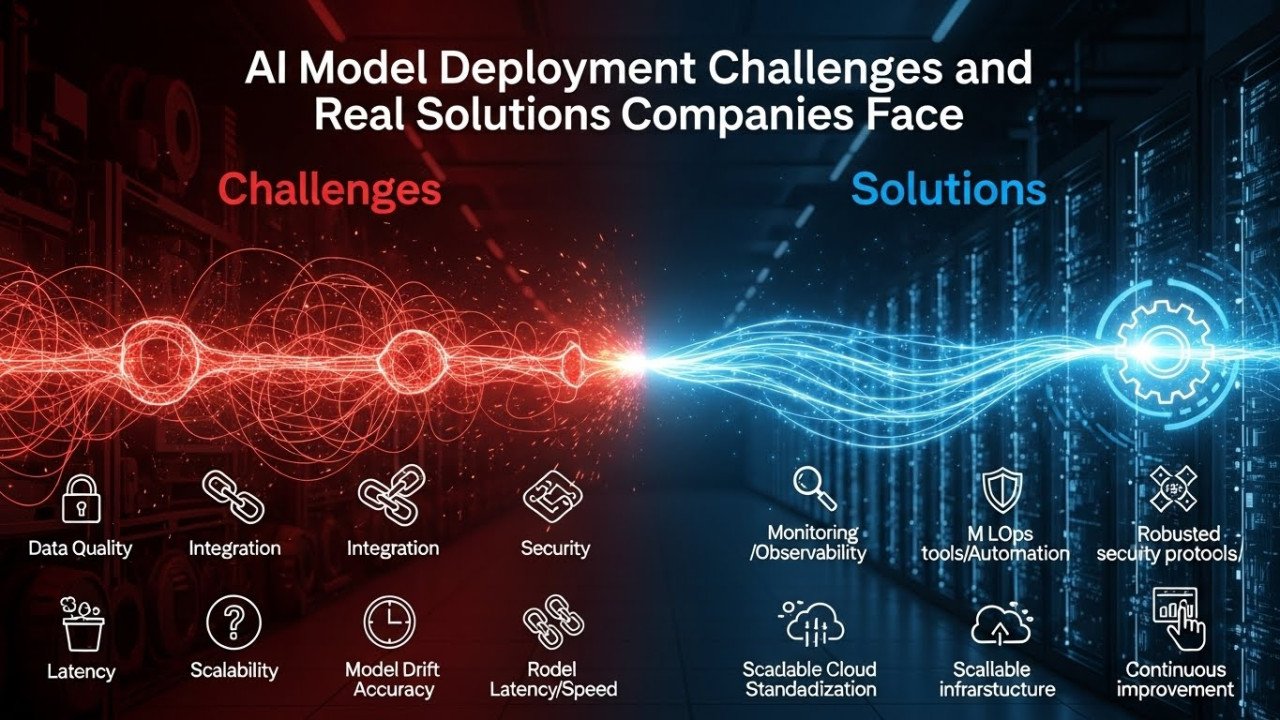
From Lab to Production: AI Model Deployment Challenges and Real Solutions Companies Face
The Production Graveyard: Why 90% of AI Models Never Ship
Stanford AI Index 2025 confirms a crushing reality: only 10-20% of AI models ever reach production. 80-90% of initiatives remain stuck in the experimental phase indefinitely. The gap isn't talent or model sophistication. It's infrastructure, data pipeline complexity, and the operational realities of running models at scale. A machine learning team can train an accurate model in weeks. It can take 24-36 weeks additional to move that model into production safely, monitor it reliably, and maintain it without creating technical debt that compounds over time.
Traditional deployment takes 6-12 months from proof-of-concept approval to production launch. Fortune 100 banks average 9-month gaps between POC and production, with only 15% of initiated models launching fully. A megabank reported spending 70% of total project time on data preparation, infrastructure setup, and testing—activities that happen after the model is already trained. The model itself was ready in week 6. Production readiness consumed weeks 7-28.
The Deployment Timeline: What Actually Takes Weeks
Week 1-2: Proof of Concept (Model Training)
Your data science team trains a model, validates performance on test data, and declares success. The model shows 92% accuracy. Everyone celebrates. This phase moves fast—sometimes days to weeks, depending on data complexity and tuning cycles. This is not where projects stall.
Week 3-6: Data Pipeline Engineering
Here's where time explodes. Raw data sits in multiple systems (databases, data lakes, file shares, APIs). Nobody built pipelines to extract, transform, and load (ETL) data consistently. Your team now must: identify all relevant data sources, build extraction logic to pull data reliably, validate data quality at each step, build transformation logic to prepare features for the model, create loading procedures to deliver processed data to the model on schedule, handle edge cases when data is missing or inconsistent, and set up monitoring to catch pipeline failures.
Most organizations discover their data infrastructure is fragmented during this phase. Data definitions differ across systems. Duplicate records exist. Historical data quality varies. Fixing these issues consumes weeks. One bank spent 6 weeks just reconciling customer IDs across systems before they could build reliable pipelines.
Week 7-12: Infrastructure and Deployment Architecture
Your model must run somewhere. Traditional approach: decide between options (AWS SageMaker, Azure ML, Kubernetes cluster, on-premise servers), set up authentication and security, configure compute resources (how many GPUs? which regions?), implement model serving infrastructure (how does the application call the model?), set up API gateways if model predictions are called by external systems, implement version control for models and code.
This phase involves security reviews, compliance checks, and architecture sign-offs that traditional software deployment never faced. If your company operates in regulated industries (finance, healthcare), add 4-8 weeks for compliance vetting. A healthcare provider spent 3 months waiting for a compliance review of their model's security architecture before deploying.
Week 13-20: Testing, Validation, and Stress Testing
Unlike traditional software, AI model testing is complex. You must test: model accuracy on historical data, model accuracy on data patterns it never saw during training, edge cases and error conditions, model performance under load (what happens when 1,000 simultaneous predictions are requested?), latency requirements (is 200ms response time acceptable? 2 seconds? different products have different needs), rollback procedures (what happens when you need to downgrade to the previous model version immediately?).
Real testing often reveals that your model performs well on average but poorly on specific customer segments, on data from certain regions, or during peak usage hours when compute resources are constrained. Fixing these issues requires retraining on more representative data, redesigning the model architecture, or changing deployment topology. These discoveries typically add 2-4 weeks to timelines.
Week 21-26: Monitoring and Observability Setup
Before production, you must set up monitoring that detects failures before customers notice. Monitoring checklist: track prediction accuracy continuously using labeled ground truth data (how do you know the model's predictions are right? you need a way to verify this after deployment), detect data drift (is incoming data different from training data? if yes, model performance probably degraded), detect model drift (is the model performing worse over time even with stable data? this signals model accuracy decay), track latency and throughput, monitor resource utilization (CPU, GPU, memory, disk), set up alerting thresholds that notify you when metrics deviate from baselines.
This infrastructure is invisible when it works. It becomes critical when it fails. Teams that skip proper monitoring deploy models confidently, then discover three weeks later that the model accuracy has degraded silently to 62%—well below acceptable thresholds—without anyone knowing. The model continued making predictions while deteriorating invisibly.
Week 27+: Production Deployment and Stabilization
Finally, the model goes live—but controlled: canary deployment (release to 1% of traffic first, monitor for issues), gradual rollout (5%, 25%, 50%, 100% over days), incident response procedures (on-call schedules, escalation processes, rollback procedures if something breaks).
Most models experience issues in their first two weeks of production. Latency is higher than predicted. Specific data patterns cause unexpected predictions. The model performs worse in production than in testing despite identical data validation procedures. Debugging these issues keeps teams firefighting for weeks. Only after 2-4 weeks of stabilization does production finally feel reliable.
Real Cost Breakdown: Infrastructure Isn't Cheap
Hardware and Compute Costs
Inference GPUs: V100 GPUs cost $20,000+ to purchase, $10-15/hour in cloud rental. A model requiring two GPUs for inference costs $240,000+ annually just for the hardware (2 GPUs × $15/hour × 8,760 hours). This assumes standard cloud pricing without discounts. Smaller models on CPUs cost less ($2,000-$5,000 annually). Larger models requiring multiple GPUs or specialized accelerators cost more ($500,000-$2M annually).
Data pipeline infrastructure: ETL systems, databases, data lakes, and processing clusters add $50,000-$300,000 annually, depending on data volume. Financial institutions with terabytes of daily transaction data pay premium prices.
Monitoring and observability: Tools to detect model drift, data quality issues, and latency problems cost $20,000-$100,000 annually,y depending on model volume and prediction frequency.
Total first-year infrastructure cost: $100,000-$1M+ depending on model complexity, data volume, and industry regulatory requirements. This is an operational expense beyond the initial deployment cost.
Personnel and Development Costs
Data engineers: Building reliable data pipelines requires specialized expertise. One senior data engineer costs $180,000-$250,000 annually (all-in). A single model might require 0.5-1 FTE of data engineering effort.
MLOps engineers: Setting up deployment infrastructure, monitoring, and observability requires practitioners who understand both machine learning and operations. Salaries: $200,000-$300,000 annually. One person can support 3-5 production models before becoming a bottleneck.
Model development and maintenance: Scientists and engineers who train models, investigate performance degradation, and retrain models. One person can maintain 5-10 models, depending on their complexity and stability. Cost: $200,000-$280,000 per person annually.
Total personnel cost first year: $400,000-$800,000 for a team supporting a single high-criticality model. This is why most organizations don't deploy a single model—they need that team to support 5-10 models to achieve acceptable ROI on the team's cost.
Why Traditional Deployment Takes 6-18 Months
Sequential Bottlenecks, Not Parallel Work
Organizations often force sequential workflows: finish model training, then start infrastructure work, then start pipeline engineering, then start testing. Each team waits for the previous team. One team's delay cascades to everyone downstream. A 2-week delay in data pipeline work blocks infrastructure setup, testing, and deployment equally. What should take 26 weeks expands to 36+ weeks with only minimal parallelization.
Organizational Friction
Who owns what? When the model fails in production, is it a data team problem, an infrastructure problem, or a model problem? Unclear ownership creates a delay. One company discovered its model accuracy degradation was caused by a database configuration change that happened outside the ML team's awareness. The team blamed the model. The database team blamed the model team for building fragile models. Resolution took 4 weeks of finger-pointing before anyone investigated the actual root cause.
Compliance and Security Reviews
Regulated industries require security reviews, compliance audits, and model explainability validation before production. These reviews often aren't on the critical path initially—they happen in parallel. But they frequently discover issues late: "The model processes PII in ways we didn't consider. We need to redesign." This discovery in week 22 means returning to design phases, adding months to timelines.
Technical Debt and Hidden Retraining
Once models ship, they require retraining. The original team built the model once. But retraining happens monthly, quarterly, or more frequently, depending on data drift. If the original code is poorly documented, retraining becomes complex. If pipelines are manual (human intervention required), retraining is slow. Technical debt incurred during initial development multiplies the cost of ongoing maintenance.
The Solution: MLOps Reduces Deployment Time to 8 Weeks
Parallel Development Instead of Sequential
Organizations using structured MLOps frameworks run data engineering, infrastructure setup, and testing concurrently. Infrastructure work begins in week 1, even though the model won't be ready until week 6. Data pipelines are designed and validated using historical data before the production model exists. Testing infrastructure is set up before the code is ready to test. When pieces converge, they fit together. Timeline compression: 6-12 months becomes 8-10 weeks.
Reusable Infrastructure Components
Instead of building from scratch each time, standardized MLOps platforms provide pre-built components: model serving infrastructure, data pipeline templates, monitoring systems, and deployment automation. Deploying the second model requires only reusing components and adapting them, not rebuilding. SmartDev reports subsequent ML deployments in under 6 weeks versus 12+ weeks for first models—because they're leveraging platform infrastructure instead of rebuilding.
Automated Testing and Continuous Integration
MLOps frameworks integrate continuous integration/continuous deployment (CI/CD) pipelines specific to machine learning: automated data quality checks run before model training, automated model accuracy tests run after training, automated canary deployments with monitoring before full rollout, and automated rollback if production metrics degrade. This automation eliminates manual testing and deployment steps that traditionally consumed weeks.
Infrastructure as Code
Instead of manually configuring servers, networks, and services through UI clicks (error-prone and time-consuming), infrastructure is defined as code and version-controlled. Deploying identical infrastructure to development, staging, and production requires running code, not weeks of manual setup. Changes are tracked, auditable, and repeatable.
Production Challenges: The Invisible Failures
Silent Model Degradation
85% of machine learning models fail silently in production. The model continues making predictions, and the system continues delivering those predictions to users—without anyone knowing the accuracy has degraded. Why? Real-world data changes. A model trained on 2024 data makes worse predictions on 2025 data if the underlying patterns have shifted. A model trained on historical patterns misses new fraud techniques. Model degradation is invisible without proper monitoring.
Example: A bank's churn prediction model was 87% accurate when deployed. Three months later, it was 71% accurate—without triggering any alerts. The team didn't discover the degradation until analyzing quarterly performance reports months after it happened. By then, thousands of customer churn predictions had been wrong, driving poor business decisions.
Data Drift and Feature Breakdown
Models are trained on historical data. New data arrives daily. If new data follows different distributions from the training data, model performance degrades. A model trained on customer data from 2024 assumes certain distributions of customer age, income, and spending patterns. In 2025, demographics shift. The model's feature distributions no longer match what it was trained on. Accuracy drops.
Specific features break too. A model using "customer email provider" as a feature works fine until a major email provider goes offline or people switch providers en masse. The feature now carries different information. Teams often don't realize specific features have broken until they deeply investigate model performance degradation.
Latency Creep and Infrastructure Constraints
Models run fast in testing. In production with real traffic, latency increases. Why? Compute resource contention (other workloads competing for the same GPU), network latency (data must travel from application server to model server to application server), disk I/O bottlenecks (models need to load data from disk), inefficient batch sizes (processing one prediction is more efficient than processing 10,000 separately, but infrastructure limits batch sizes due to memory constraints).
Latency that was 100ms in testing becomes 500ms or 2 seconds in production. For user-facing applications, this is unacceptable. For backend systems, it still matters—latency in one system cascades to latency elsewhere. Teams end up overprovisioning infrastructure (adding more GPU capacity than strictly necessary) to mask latency problems. Cost explodes.
Retraining Failures and Model Staleness
Models must be retrained regularly to prevent degradation. But retraining often fails. New data introduces edge cases that the original training process didn't handle. Feature distributions are different, causing the training pipeline to fail. Retraining jobs that run on schedule just stop working without anyone investigating why. The production model remains stale, accuracy degrades, but retraining never happens because it's broken.
One recommendation engine experienced retraining failures for 3 weeks before anyone noticed. The production model became progressively stale, serving increasingly irrelevant recommendations. Users complained. Investigation revealed the automated retraining had been failing silently since week 1, but monitoring only alerted to critical failures, not failures with retries.
Proven Solutions: Monitoring, Alerting, and Automated Response
Monitoring for Model Drift
Monitor feature distributions continuously. Calculate the statistical distance between the training data distributions and the new production data. When distance exceeds thresholds, alert. Set thresholds conservatively so you catch degradation early—before accuracy is severely impacted. One company monitors Wasserstein distance between training and production feature distributions, alerting when the distance grows beyond 0.15. They catch 95% of model drift events within hours instead of days or weeks.
Prediction Drift Detection
Monitor the distribution of model predictions themselves. If your model suddenly predicts "churn = yes" for 45% of customers when it previously predicted yes for 12%, something has changed. This indicates concept drift—real-world patterns shifted. Automatic alerts trigger retraining or rollback to the previous model version.
Latency and Resource Monitoring
Track model inference latency percentiles (p50, p95, p99). Track GPU/CPU utilization, memory consumption, and disk I/O. When utilization exceeds 80%, capacity is constrained, and latency will soon increase. Predictive monitoring forecasts latency problems hours before they occur, triggering autoscaling before users experience slowdowns.
Automated Canary Deployments
Deploy new model versions to 1% of traffic. Monitor performance on that segment. If accuracy remains high, gradually increase to 5%, 25%, 50%, 100%. If degradation is detected, automatically roll back. This approach catches model issues in production before they affect all customers. Automation eliminates manual decision-making—the system detects and responds faster than humans can.
Key Takeaways
- 90% of AI Models Never Reach Production: Only 10-20% of initiatives deploy successfully. The gap is in infrastructure and operational readiness, not model quality.
- Traditional Deployment Takes 6-18 Months: Model training takes 2-6 weeks. Data pipeline engineering, infrastructure setup, testing, and compliance reviews consume 20-36 additional weeks. Sequential workflows extend timelines further.
- Infrastructure Costs Are Hidden: Compute costs ($100K-$1M annually), personnel costs ($400K-$800K annually for one model team), and operations complexity add up quickly. Most organizations need to support 5-10 models to achieve an acceptable ROI on team costs.
- Sequential Bottlenecks Drive Delays: Teams waiting for data pipeline work to finish before infrastructure work stalls entire projects. Parallelizing work requires planning from day one.
- 85% of Models Fail Silently: Model accuracy degrades invisibly without monitoring. Three months of poor predictions can occur before anyone discovers degradation through periodic reviews.
- Data Drift Degrades Accuracy Continuously: Models degrade 15-25% within six months as real-world data patterns shift away from training data distributions. Automated retraining is mandatory, not optional.
- MLOps Compresses Timelines to 8-10 Weeks: Parallel development, reusable components, automated testing, and infrastructure-as-code reduce deployment from 6-12 months to 2 months. Subsequent models deploy even faster (4-6 weeks) by reusing platform infrastructure.
- Production Readiness Matters More Than Model Quality: A 90% accurate model that never ships is worthless. An 85% accurate model deployed, monitored, and maintained reliably is valuable. Infrastructure and operations determine success more than raw model performance.
The Verdict: Deployment Infrastructure Determines Success
Building accurate AI models is the easy part. The hard part is deploying them reliably, monitoring them continuously, retraining them automatically, and maintaining infrastructure without incurring technical debt that makes future deployments expensive and slow. Organizations that view deployment as critical from day one—building MLOps infrastructure, planning for monitoring before deployment, designing for retraining automation—compress timelines dramatically and improve success rates. Those treating deployment as an afterthought watch 80% of their projects stall in the experimental phase, wasting millions in personnel and compute costs on initiatives that never reach production or revenue generation.
Related Articles
- Google AI Overviews: Why They're Killing SEO Traffic (And How to Adapt)
- AI Search vs Traditional SEO: The Skills You Need to Master in 2025
- Real-World AI ROI: Case Studies Showing 300–650% Returns Across Industries (With Exact Metrics
- Practical AI Applications Beyond ChatGPT: How Enterprises Actually Use Generative AI to Drive Revenue
- AI Hallucinations Explained: Why AI Confidently Generates False Information (And How to Fix It)
- E-E-A-T Signals in AI Content: How Google Quality Raters Actually Evaluate AI-Generated Pages





Comments (0)
No comments found