


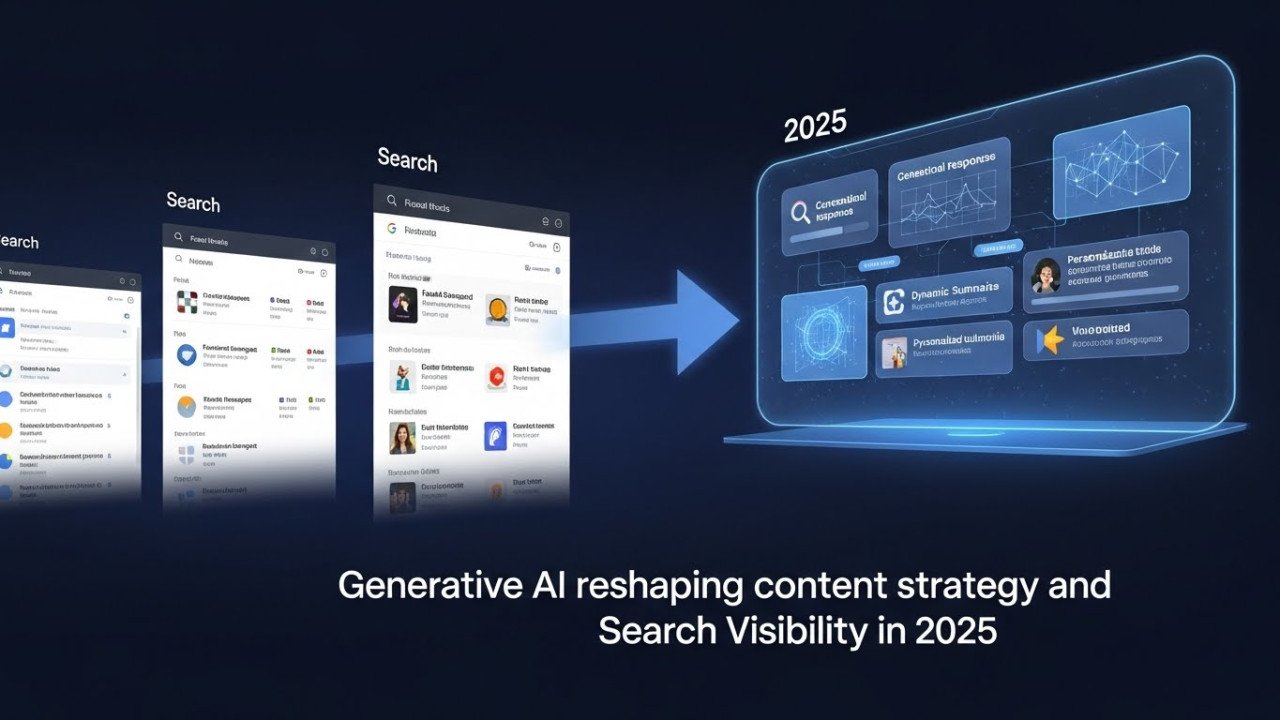
Generative AI SEO 2025: Revolutionizing Search Visibility & Content Strategy
The Evolution of Search and SEO: How Generative AI Is Reshaping Content Strategy and Search Visibility in 2025
The search industry stands at a fundamental inflection point where artificial intelligence has transformed from emerging capability to core search infrastructure, fundamentally reshaping how information is discovered, how search engines operate, and what strategies enable content visibility and audience reach. The transformation is profound: Google now integrates AI-generated "Overviews" directly into search results, displacing traditional organic rankings; generative AI search engines like Perplexity AI and OpenAI's SearchGPT provide direct answers without requiring webpage clicks; and search engine optimization itself has evolved from keyword placement tactics to sophisticated content strategy emphasizing expertise, experience, and authoritative information architecture. The implications are simultaneously disorienting and clarifying: content optimization requires rethinking fundamental assumptions about search visibility, audience reach, and content value propositions that drove SEO strategy for two decades.
Yet beneath apparent disruption lies deeper continuity: search fundamentally remains about connecting information seekers with authoritative, relevant content addressing their needs—whether through traditional blue-link results, AI-generated overviews, or direct answers from generative systems. Organizations that adapt SEO strategy to account for AI's transformation—building content addressing searcher intent more deeply, emphasizing topical authority and expertise signals, optimizing for multiple result formats simultaneously—position themselves to capture visibility in evolving search landscapes. Conversely, organizations clinging to outdated SEO tactics (keyword stuffing, thin content, manipulative link building) find their visibility collapsing as search algorithms increasingly reward substantive content and penalize low-quality tactics.
This comprehensive guide examines the mechanisms through which AI is transforming search, the implications for content strategy, the evolution of SEO practices, and the frameworks enabling organizations to capture visibility and audience reach in 2025's radically reshaped search environment.
How AI Search Fundamentally Differs From Traditional Search
The Shift From Links to Content Authority
Traditional SEO operated on a foundational assumption: links are votes of confidence representing authority. Websites with more inbound links ranked higher; link building was primary SEO tactic; content was often secondary to link acquisition strategy. This model worked reasonably well when link acquisition required effort and genuine endorsement; degraded as SEO became industrialized and link buying/building became routine; and ultimately became inadequate as search engines recognized that link-based authority could be manipulated.
AI-powered search engines take fundamentally different approach: rather than analyzing links as external authority signals, they analyze content itself—its depth, accuracy, topical coverage, alignment with searcher intent, and consistency with authoritative sources. A website with no inbound links but exceptional content addressing searcher needs comprehensively ranks highly; conversely, websites with many links but shallow content ranks poorly. This shift has profound implications: content quality becomes primary ranking factor; links remain relevant but no longer dominate; and topical expertise signals (EEAT—Experience, Expertise, Authoritativeness, Trust) drive visibility.
AI Overviews and Displaced Traditional Rankings
Google's introduction of "AI Overviews"—AI-generated summaries appearing above traditional search results, synthesizing information from multiple sources to directly answer searcher questions—fundamentally altered search result presentation and visibility economics. Rather than organic rankings determining what users see first, AI-generated content now often appears above all traditional results.
This shift creates both opportunity and challenge: opportunity because AI Overviews cite sources, and appearing in overviews drives traffic despite not being the primary result; challenge because traditional top rankings provide less visibility when users scroll past AI Overviews to find traditional results. Organizations must optimize for multiple result formats: traditional rankings, AI Overview inclusion (indicating content was authoritative enough to inform AI synthesis), featured snippets, and direct answer boxes.
Generative AI Search Engines as Direct Competitors
Perplexity AI, OpenAI's SearchGPT, Google's Gemini, and similar generative AI search engines answer questions directly without requiring users to click to external websites. Unlike Google search (which monetizes through ads on search results pages), these direct-answer systems provide immediate solutions, reducing traffic to publisher websites.
This competitive dynamic creates SEO necessity: content must be positioned where generative AI systems cite it as authoritative sources. Perplexity cites sources for its answers; organizations appearing in those citations drive traffic. This requires building content demonstrating clear expertise, featuring unique data or perspectives unavailable elsewhere, and establishing authoritative positioning within specific domains.
The New SEO: EEAT, Topical Authority, and Content Depth
EEAT Signals: From Nice-to-Have to Essential
Google's emphasis on Experience, Expertise, Authoritativeness, and Trust (EEAT) has evolved from guidance into core ranking algorithm factor. Content from subject matter experts outranks generalist content; content from experienced practitioners outranks theoretical knowledge; websites with demonstrated authority in specific topics outrank generalist sites; content from trustworthy sources (supported by credentials, citations, institutional affiliation) outranks anonymous content.
Practically implementing EEAT involves:
Author expertise signals: Publishing author bios clearly stating credentials, relevant experience, and expertise—enabling search engines to understand who created content.
Institutional affiliation: Establishing clear relationships between content creators and authoritative organizations—academic institutions, professional organizations, government agencies.
Citation and reference practices: Citing authoritative sources, linking to research backing claims, and demonstrating knowledge grounded in established expertise rather than speculation.
Consistent topical focus: Concentrating content around specific topics where expertise is deep, enabling demonstration of genuine knowledge rather than surface-level coverage across countless topics.
External validation: Appearing in publications, being cited by other experts, speaking at industry conferences—all signal authority to search algorithms.
Topical Authority: Depth Over Breadth
Rather than building websites across diverse topics, modern SEO emphasizes topical authority—concentrating expertise and content around specific knowledge areas, creating comprehensive resources establishing dominance within particular niches. A website with 500 in-depth articles on digital marketing ranks higher than sites with 5,000 articles across varied topics.
Building topical authority involves:
Topic cluster architecture: Organizing content around core topics supported by comprehensive, interlinked subtopics and supporting content—creating semantic relationships search algorithms recognize.
Comprehensive coverage: Addressing topics exhaustively, covering multiple angles, answering common questions, and providing information at varying depths—from introductory overviews to advanced specialist content.
Internal linking strategy: Deliberately linking related content, building semantic connections, and establishing information architecture that demonstrates relationships between topics.
Consistent expertise: Ensuring all content reflects genuine expertise and maintains consistent quality standards rather than mixing expert analysis with superficial coverage.
External corroboration: Earning citations and links from external authorities confirming expertise—other experts referencing your content, industry publications citing your research.
Content Depth and Comprehensiveness
AI search algorithms dramatically reward comprehensive, in-depth content addressing questions thoroughly and authoritatively. The era of thin, keyword-optimized pages is definitively over; 2000+ word articles addressing topics comprehensively outrank shorter content dramatically.
Depth implementation includes:
Thorough research: Going beyond surface-level information to provide genuine insights, original research, data analysis, case studies, and expert perspectives.
Multiple angles and perspectives: Addressing topics from different viewpoints, covering various contexts, and acknowledging nuance and complexity rather than oversimplifying.
Original data and research: Conducting surveys, analyzing datasets, or performing research generating unique insights unavailable elsewhere.
Practical application: Moving beyond theory to provide actionable guidance, concrete examples, case studies, and implementation frameworks.
Regular updates: Keeping content current with evolving information, maintaining relevance, and demonstrating ongoing expertise engagement.
SEO Content Strategy Evolution: From Keywords to Intent
Search Intent Mapping and Fulfillment
Rather than optimizing for keywords in isolation, modern SEO begins with search intent analysis—understanding why people search specific terms and what information would satisfy their needs. Intent typically falls into categories:
Informational intent: Searchers seeking knowledge, understanding, or education—"how does photosynthesis work," "best practices for remote team management".
Transactional intent: Searchers wanting to purchase, book, or complete transactions—"best laptop under $1000," "book hotel in Portland".
Local intent: Searchers seeking nearby businesses or services—"restaurants near me," "urgent care downtown".
Navigational intent: Searchers seeking specific websites or brand properties—"Facebook login," "Amazon Prime".
Exploratory intent: Searchers comparing options, researching before purchase decisions—"iPhone vs Android," "SaaS vs on-premise software".
Effective SEO matches content to search intent precisely: informational content for research phases; comparison content for evaluation phases; transactional content for purchase-ready audiences. Content misaligned with intent ranks poorly despite covering relevant topics.
Query Variations and Semantic Coverage
Modern content optimization addresses not single keywords but semantic clusters—related terms searchers use expressing similar intent. Rather than optimizing for "best project management software," comprehensive coverage addresses "project management tools," "project management software comparison," "top project management platforms," "free project management solutions"—all variations expressing the same core informational need.
Semantic coverage implementation involves:
Keyword research identifying variations: Using tools like SEMrush, Ahrefs, or Moz to identify related terms and variations searchers actually use.
Natural language integration: Incorporating variations naturally within content without forced keyword insertion.
Topic modeling and clustering: Grouping related content, building internal linking connections, and establishing semantic relationships.
Featured snippet optimization: Formatting content to answer specific questions clearly, improving likelihood of appearing in featured snippets.
Optimizing for AI-Integrated Search Results
Featured Snippets and Direct Answer Optimization
AI systems frequently draw information from featured snippets—specially formatted content appearing in boxes above traditional rankings designed to answer queries directly. Optimizing for featured snippets involves:
Question-answer format: Creating clear Q&A sections addressing common questions directly.
Structured data markup: Using schema markup (FAQ schema, HowTo schema) enabling search engines to parse and extract answers.
Concise answers: Providing clear, direct answers to questions (ideally 40-60 words) that featured snippets prioritize.
Comprehensive coverage: Ensuring content addresses questions thoroughly enough that search algorithms recognize it as authoritative.
Visual optimization: Using tables, lists, images, and other visual formats that featured snippets often capture.
AI Overview Inclusion Strategy
Appearing in Google's AI Overviews requires being recognized as authoritative source on topics. Strategies include:
Comprehensive topical coverage: Creating content so authoritative that AI systems draw from it when synthesizing overviews.
Citation-worthy content: Developing unique data, research, or perspectives compelling enough for AI systems to cite.
Clear source attribution: Ensuring content clearly identifies your organization so citations drive traffic.
Structured data implementation: Using schema markup helping AI systems parse and understand your content structure.
External corroboration: Earning citations from other authoritative sources reinforces your authority.
Generative AI Search Optimization
For generative AI search engines like Perplexity, optimization strategies include:
Direct answer provision: Answering questions thoroughly and clearly—these systems preferentially cite content providing direct answers.
Unique data and insights: Providing information unavailable elsewhere ensures your content competes for citation.
Clear authority signals: Establishing credibility through author expertise, institutional affiliation, and external validation.
Comprehensive source documentation: Properly citing sources and referencing validates your content as reliable information source.
Regular content updates: Keeping information current ensures relevance when AI systems select sources.
The Ongoing Importance of Technical SEO and User Experience
Core Web Vitals and Page Experience
Despite AI's content-centric focus, technical fundamentals remain critical: page speed, mobile responsiveness, visual stability, and overall user experience continue driving search visibility. Core Web Vitals (Largest Contentful Paint, First Input Delay, Cumulative Layout Shift) directly affect rankings.
Technical optimization priorities include:
Page speed optimization: Target load times under 2.5 seconds; optimize images, minify code, implement caching.
Mobile-first design: Ensure responsive design, touch-friendly navigation, and mobile-optimized content.
HTTPS security: Implement SSL certificates; all resources must load securely.
Structured data implementation: Add schema markup enabling search engines to parse content structure.
Accessibility: Ensure content accessibility for users with disabilities; proper heading hierarchy, alt text for images, keyboard navigation.
User Experience Signals
Search algorithms increasingly weight user behavior signals: time on page, bounce rate, scroll depth, click-through rate from search results. Content engaging users demonstrates greater value than content users quickly abandon.
Improving user experience signals involves:
Compelling headlines: Creating hooks encouraging clicks from search results.
Clear value proposition: Immediately showing readers content addresses their needs.
Engaging format: Using visuals, lists, short paragraphs, and other readable formatting maintaining engagement.
Comprehensive answers: Ensuring content thoroughly addresses searcher needs reducing bounce rate.
Internal linking: Guiding users to related content increasing session time and engagement.
Practical Content Strategy for 2025 and Beyond
Audit Existing Content Against New Standards
Organizations should systematically evaluate existing content against modern SEO standards:
EEAT assessment: Does content clearly demonstrate author expertise? Does it reference authoritative sources? Does it carry institutional credibility signals?
Topical authority evaluation: Does content fit within coherent topical focus? Or is website scattered across unrelated topics?
Depth and comprehensiveness: Is content superficial or genuinely comprehensive? Does it address questions thoroughly?
Search intent alignment: Does content match what searchers actually need? Or does it address slightly different intent?
Technical performance: Do pages load quickly? Are they mobile-optimized? Is structured data implemented?
Develop Topically Focused Content Strategy
Rather than scattered content across diverse topics, build focused expertise:
Identify core topic areas: Where do you have genuine expertise? What topics serve your audience?
Create comprehensive coverage: Develop content addressing core topics thoroughly—from beginner introductions through advanced specialist content
Build topic clusters: Organize content into coherent clusters with clear semantic relationships
Implement strategic internal linking: Link related content, building semantic connections
Establish author expertise: Clearly identify authors with relevant credentials and experience
Adapt SEO Practices to AI Search Realities
Optimize for multiple search formats: Develop content appearing in traditional rankings, AI Overviews, featured snippets, and generative AI search results.
Build for citation: Create unique data, research, and insights compelling enough for AI systems to cite.
Emphasize expertise signals: Make author credentials, research methods, and information sources transparent.
Update content regularly: Keep information current; demonstrate ongoing expertise engagement.
Test and iterate: Monitor AI search visibility, featured snippet placement, and generative AI citation; test variations; iterate toward better performance.
Conclusion: SEO's Continued Relevance in AI-Transformed Search
The transformation of search through AI fundamentally reshapes SEO but doesn't eliminate its importance. The principles underlying SEO—connecting information seekers with authoritative, relevant content addressing their needs—remain constant even as mechanisms evolve. Organizations that adapt to AI-transformed search—emphasizing content depth and authority, building topical expertise, and optimizing for multiple result formats—capture sustainable visibility and audience reach.
The organizations succeeding in 2025 and beyond are those recognizing that modern SEO is fundamentally content strategy: creating genuinely valuable, expertly crafted, thoroughly researched content addressing real audience needs. The technical optimizations, link building tactics, and keyword strategies that once dominated SEO remain relevant only insofar as they support this core mission of delivering authoritative, excellent content. Success flows from this principle applied consistently across evolved search ecosystems.



Comments (0)
No comments found