


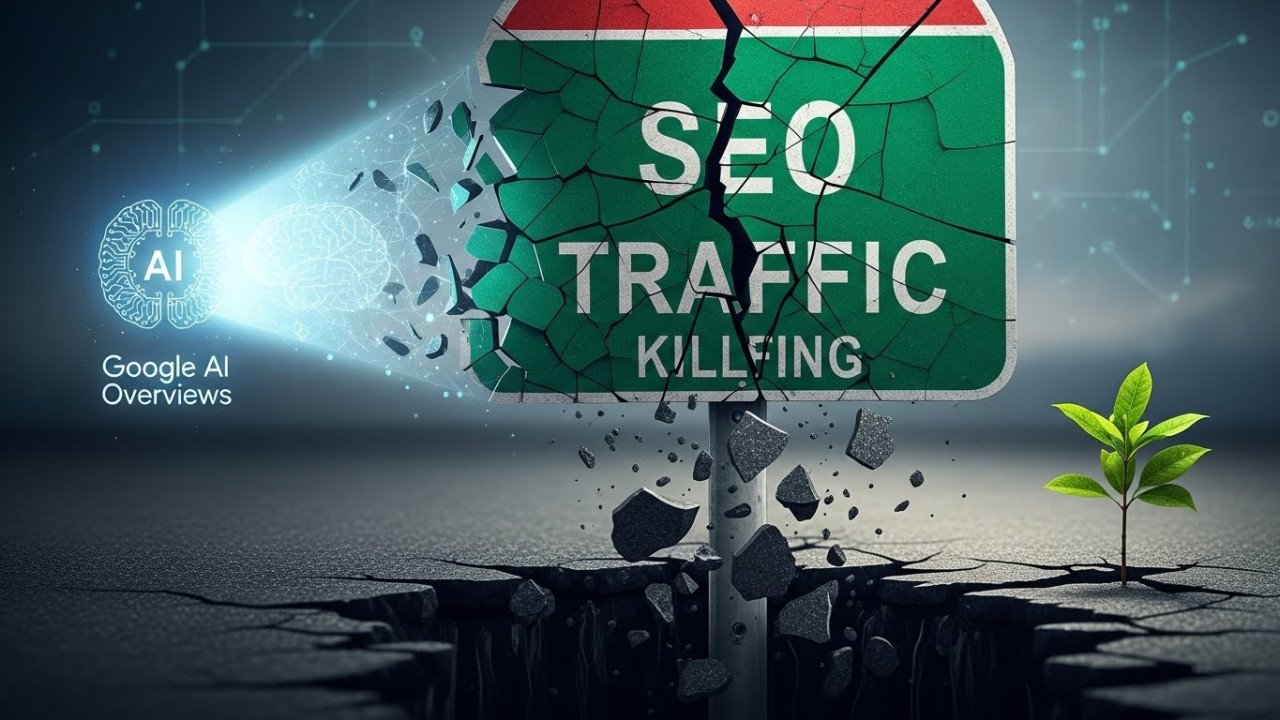
Google AI Overviews: Why They're Killing SEO Traffic (And How to Adapt)
The Zero-Click Crisis
Google AI Overviews synthesize answers directly on the search results page. In December 2025, they appear on 51-80% of informational queries. But here's the problem: users get their answer without clicking through to your website.
Content creators report catastrophic traffic declines. Your article ranks #1. AI Overview displays your content. The user reads the answer on Google. Never visits your site. $0 revenue.
📉 Real Traffic Impact by Content Type
- Informational blog posts: -35% to -45% traffic decline
- How-to guides: -25% to -35% traffic decline
- Product comparisons: -20% to -30% traffic decline
- E-commerce product pages: -2% to -5% (minimal impact)
- News articles: -8% to -12% (news boxes reduced clicks)
AI Overview Triggering Patterns
Queries LIKELY to Trigger Overviews (65-78% rate)
- Questions: "What is...", "How do I...", "Why does..."
- How-to topics: "How to change oil", "Best way to..."
- Comparisons: "vs" queries, "differences between."
- Definitions: "What is X"
- Statistics: "Average cost of...", "Market size of..."
- Explainers: Educational content queries
Queries UNLIKELY to Trigger (5-12% rate)
- Brand/transactional: "Buy Tesla Model 3 near me."
- Navigation: "Facebook login", "Gmail.l"
- Very specific long-tail: "Best sourdough starter recipe for high altitude in Denver.er"
- Local: "Best restaurants in [city]" (local pack instead)
Content Sites Most Affected
| Website Type | Traffic Impact | Why |
|---|---|---|
| Wikipedia | -40% | Cited heavily in Overviews, users get summary on SERP |
| Health/medical blogs | -35% | Mayo Clinic, WebMD compete with Overviews |
| Tutorial sites (How-To Geek, WikiHow) | -35% | Step-by-step guides pulled into Overviews |
| DIY/lifestyle blogs | -30% | Instructional content prime for synthesis |
| Tech blogs | -20% | Still ranked in traditional results + Overviews |
| E-commerce | -3% | Shopping Overviews less common |
Why AI Overviews Hurt Content Creators
The fundamental problem: Synthesized answers reduce the need to visit source websites.
The old workflow (2023):
- User searches "Best exercises for lower back pain."
- Google shows 10 links
- User clicks #1 result → visits your blog
- Your site gets traffic, ad impressions, and affiliate clicks
The new workflow (2025):
- User searches "Best exercises for lower back pain."
- Google AI Overview synthesizes answers from 5-7 sources on SERP
- User reads the answer on Google itself
- User doesn't click → your site gets zero traffic
- BUT: Your content is still used in Overview (just not cited)
The worst part: Your #1 ranking provides no advantage. You're still losing traffic.
Adaptation Strategy 1: Optimize for Citation Inclusion
If You Can't Beat Overviews, Join Them
Goal: Make your content the primary source AI citations pull from
Optimization tactics:
- Clear structure: Use H2/H3 headers (easier to extract)
- Scannable format: Bullet points, numbered lists, short paragraphs
- Data-backed: Include statistics, charts, tables (Overviews favor these)
- Lead paragraphs: Topic sentence first (AI extracts this)
- Avoid jargon: Clear language reduces misinterpretation
Example structure that gets cited:
# How to Optimize Photos for Web ## File Size vs Quality Trade-off - JPG format: 30-50% file size reduction - WebP format: 50-70% reduction, better quality - PNG: 10-20% file size compared to JPG ## Recommended Settings - Resolution: 1920px max width - Quality: 75-85% JPEG quality - Compression: Enable gzip on server
Why this works: Structured, data-backed, easy for AI to extract and cite.
Adaptation Strategy 2: Shift to Commercial Content
Key insight: Pure informational content hit hardest. Commercial content survives.
Shift your content:
- From: "How to choose a coffee maker" → To: "Best coffee makers under $100 (buying guide with links)."
- From: "What is SEO??" → To: "SEO services for your business.s"
- From: "Benefits of meditation" → To: "Meditation apps comparison.on"
Why this works: Overviews primarily synthesize informational queries. Commercial intent queries have low Overview triggering (12% vs 65% for informational).
Traffic impact comparison:
- Pure informational: -40% traffic (due to Overviews)
- Informational + commercial mix: -15% traffic (links drive clicks)
- Pure commercial/transactional: -2% traffic (Overviews rare)
Adaptation Strategy 3: Build Direct, Owned Audiences
The problem: You're dependent on the Google algorithm. One change kills traffic.
The solution: Build audiences that don't require Google ranking.
Direct channels:
- Email newsletter: 1,000-10,000 subscribers = recurring traffic source
- Social media: TikTok, YouTube, LinkedIn, Twitter (algorithm-based but diversified)
- Direct URL repeat visitors: Brand loyalty
- Community: Discord, Slack communities, forums
- Paid advertising: Google Ads, Facebook Ads, YouTube Ads
Reality check: Major content sites (Wirecutter, Verge, Wired) now get 40-60% traffic from direct/social, not search. Search dependency? Gone.
ROI: 6-month shift to diversified traffic = 60% less dependence on search algorithm changes.
Adaptation Strategy 4: Create Original Research
Why this works: AI Overviews synthesize existing public information. Original research cannot be synthesized—you're the only source.
Examples AI Overviews cannot synthesize:
- Original surveys ("We surveyed 1,000 users about their email habits")
- Proprietary data ("Our analysis of 50,000 SaaS contracts")
- Expert interviews (unique to your publication)
- Case studies (specific to your client)
- Original experiments ("We tested 20 AI tools")
SEO benefit: Original research often cited by multiple publications → backlinks → authority → can compete even with AI Overviews.
Content format: Long-form research reports (15,000-20,000 words) with data visualization → harder for Overviews to condense, becomes a "primary source."
Adaptation Strategy 5: Build Topical Authority
Why this works: AI Overviews favor authoritative sites. If you own a topic cluster, you're harder to dethrone.
Implementation example: "Email Marketing" cluster
- Hub article: "Email marketing guide" (10,000 words)
- Spoke 1: "A/B testing email campaign.s"
- Spoke 2: "Email segmentation strategies."
- Spoke 3: "Deliverability best practices."
- Spoke 4: "Email automation workflows."
Internal linking: Interconnect spokes → hub → Google sees you as authoritative → ranks multiple results from your site → more traffic despite Overviews.
Result: Even if Overview appears, your site gets 2-3 results on page 1 → clicks distributed across multiple pages → 20-30% traffic recovery.
The SEO Playbook for 2025-2026
✅ 7-Step Action Plan
- Audit traffic: Identify queries losing traffic to Overviews (Search Console)
- Add commercial intent: Convert informational articles to commercial (product links, services)
- Build direct audience: Email, social, community (target: 30% of traffic from direct)
- Create original research: Content AI Overviews can't synthesize
- Optimize for citations: If you'll be synthesized, optimize the snippet
- Diversify traffic: Reduce Google dependency from 70% to 40%
- Build topical authority: Own topic clusters, not individual articles
Final Verdict
AI Overviews aren't going away. Denying it won't help. The smartest content creators are already:
- ✅ Optimizing for inclusion (if can't beat Overview, join it)
- ✅ Adding commercial elements (even Wikipedia added donation prompts)
- ✅ Building direct audiences (email, social)
- ✅ Creating original research (only source Google must cite)
The content sites that survive 2026 won't be those that fought AI OverviewsThere'lladaptl be those who aadapt
Related Articles
- AI Photography Revolution 2026: Strategic Adaptation & Market Survival Guide
- AI Image Generation Mastery 2025: Expert Strategies for Studio-Quality Results
- AI Image Generation for Designers 2026: Strategic Implementation & Competitive Advantage
- DALL-E 3 vs Midjourney vs Flux Tested: Which AI Generator Actually Delivers for Marketing Teams

Comments (0)
No comments found